Fully Revised and Updated Language Arts Guides

Share this post via email


Submit

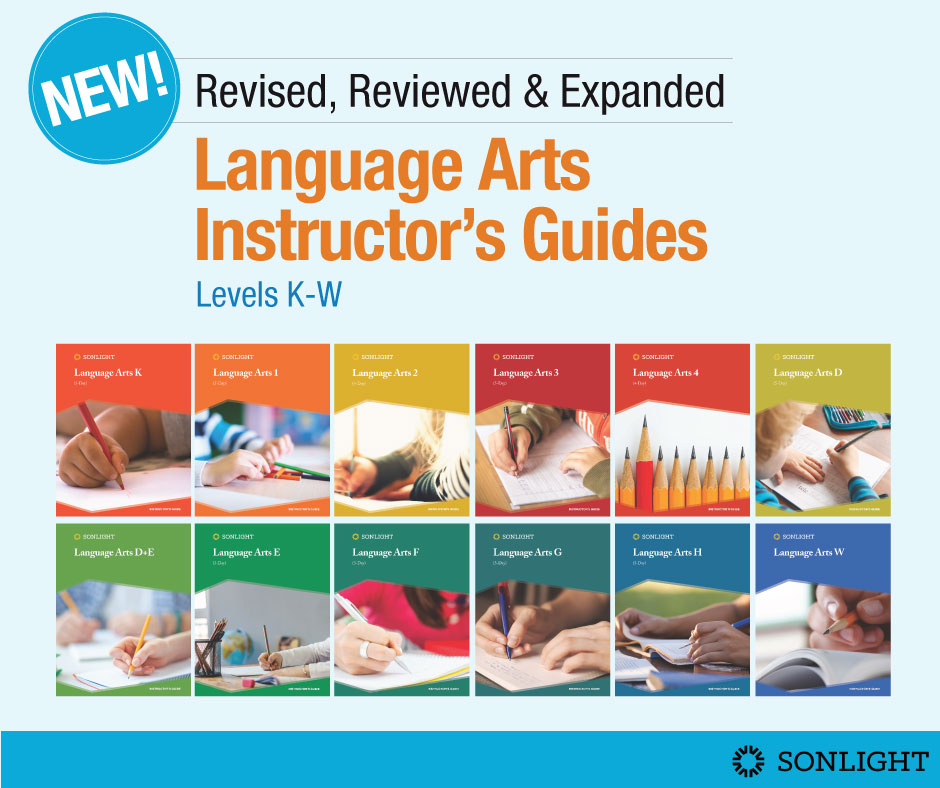
We at Sonlight are thrilled to announce our completely revised and updated Language Arts Instructor’s Guides for Levels K through W (all levels below high school).

If you’ve been part of the Sonlight family for very long, you have heard the glowing reviews of our beloved History / Bible / Literature programs, and the less than glowing reviews our Language Arts. Although our Language Arts programs produce excellent writers, and many families use them with great success, we want more customers to experience that same success.

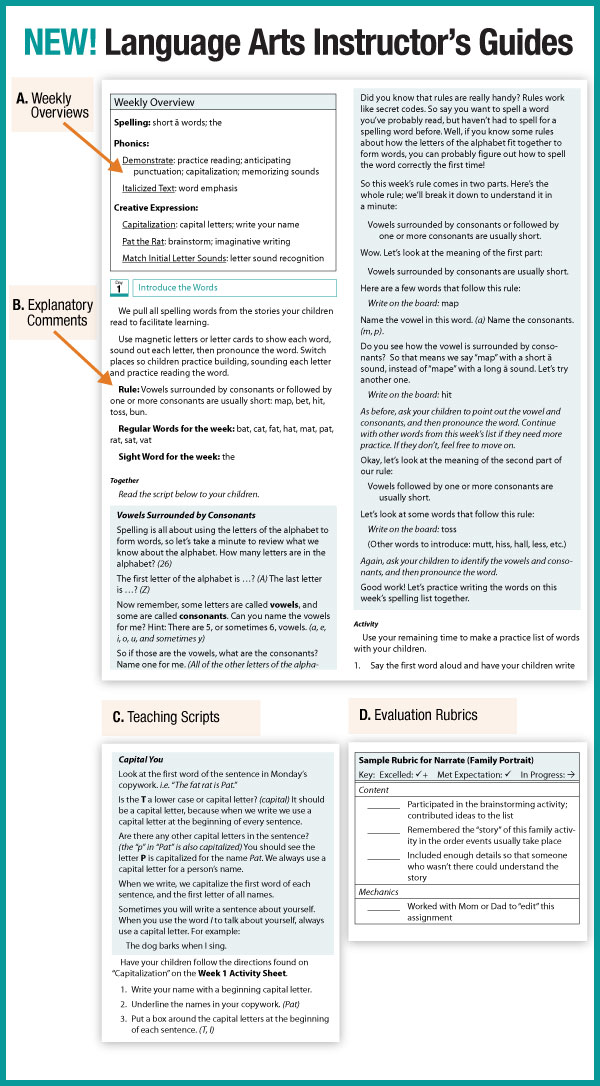
So our product development team went through every aspect of Sonlight's Language Arts programs and produced a set of new, awesome tools (complete with glowing reviews by our beta testers!). In this year's guides, you'll find completely rewritten lesson plans including:

What's New in Sonlight Language Arts

  • Simple overview summaries for each week. What are you covering? Know at a glance.
  • Education for you, so you understand what you’re doing, what your goals are, and why the Sonlight method works. For example, why we don’t want your children to learn “by rote.”
  • Teaching scripts in the early grades to read to your children. Easily introduce new ideas, concepts, and assignments. If you’re just starting to homeschool, this will help you.
  • Evaluative rubrics. A rubric is a tool for teachers so they know how to objectively evaluate students’ performance. It’s a list of characteristics you want to look for to figure out how your children are doing. For example, did your children think through a beginning, middle and end to the stories they wrote? Did they do so Excellently? As Expected? Or are they In Progress? If you aren’t confident with grading, these rubrics will help you know what to look for so you can assess with assurance.

What’s Updated in Sonlight Language Arts

  • After a big picture overview, the assignments progress in a logical order, starting with the simple and moving to the more complex. This applies both within each year and through the years as a whole.
  • Revised assignments, making sure all are a reasonable length.
  • Many new and revised activity sheets.

Click on the image to open a larger version.

We're looking forward to the 2017 programs, and we'll continue to share all the exciting updates coming March 30. Until our next update, be sure to check out our website and stay connected via our blog or forums.

Questions? Let me know below, and I’ll do my best to clarify!

Share this post via email


Submit
Tagged , | 19 Comments

3 Reasons for Homeschoolers to Pursue Extracurricular Activities

Share this post via email


Submit

Homeschoolers benefit from extracurricular activities in many ways. Discover why your family may need to start pursuing extracurriculars.

Continue reading
Share this post via email


Submit
Tagged , , , | 7 Comments

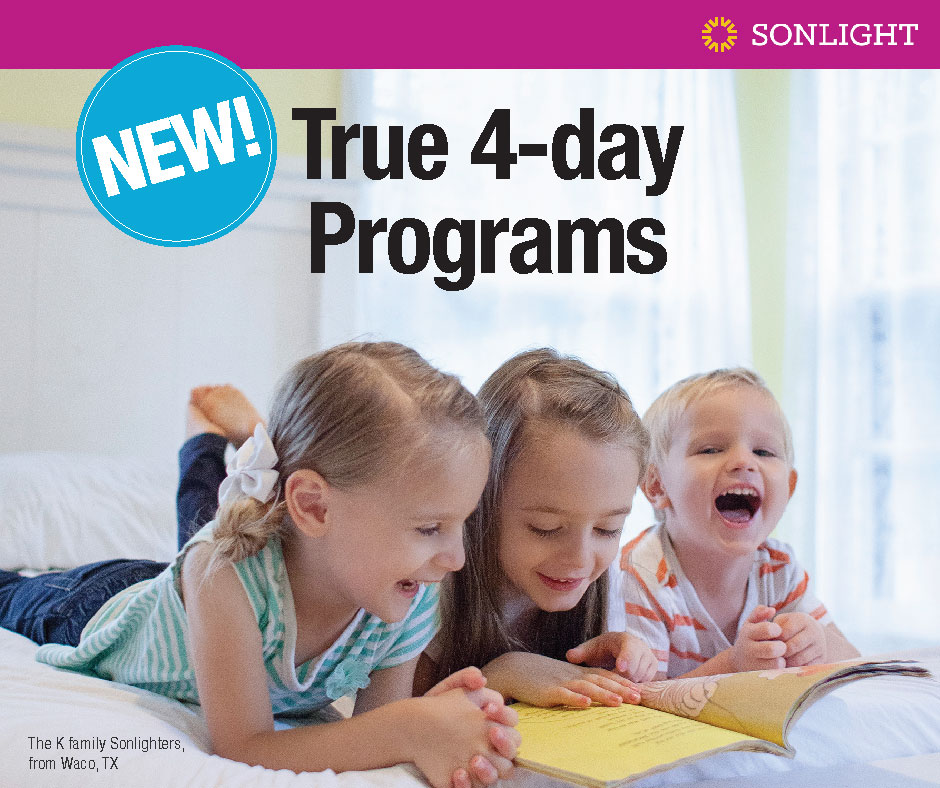
Sonlight's New, True 4-Day Programs

Share this post via email


Submit

Sonlight's New, True 4-Day programs • homeschool curriculum

Do any of these apply to you?

  • You’re in a homeschool co-op
  • You enjoy a lot of field trips
  • Your children have weekly appointments
  • You like a Friday “fun day,” with tea and poetry, math games, and art
  • You prefer to homeschool at a more relaxed pace

If so, we designed Sonlight’s new 4-day programs with you in mind! You can do Sonlight only four days a week and take the fifth day for anything you choose.

Introducing Sonlight’s all-new Instructor’s Guides (IGs)

Available on March 30, 2017 for Sonlight programs A, B, C, D, E, and F.

In these new IGs, you’ll find all subjects scheduled just four days a week.

The standard 5-day program will still be available for all programs.

A brief history of Sonlight’s 4-day Programs

For the curious—and to help clarify, because we’ve made this complex through the years—here is a summary of Sonlight’s 4-day journey.

When Sonlight began, and for many years after that, all Sonlight programs were 5-day.

Then, with so many homeschoolers enjoying co-ops, we added a 4-day option. Because research shows that beginning readers are well-served with daily practice, and because Bible is a wonderful thing to include as part of each day, both Bible and Readers remained 5-day. Which is great in concept, but a bit frustrating in practice. (Do Bible reading as you’re heading out the door to co-op? It’s maybe a bit much.)

From 2012-2015, Sonlight’s 4-day program became the foundation, with an optional fifth day added on. This was nice, in the sense that everyone got to enjoy the same books at the same rate, and if you wanted to switch to 4-day for a bit, you could. But it was a bummer, really, to have a tacked-on fifth day.

In 2016, the Instructor’s Guides were dramatically updated. All programs up to high school were re-done, with updated book choices and tighter reading lists. Because of the reduced reading load, we also created a 4-day program with the same books, read at a slightly faster pace.

In 2017, you will get to choose an entirely new product.

  • Fewer books (since you are Sonlighting 36 fewer days!)
  • All Instructor’s Guides updated: History / Bible / Literature, Language Arts, and Science
  • All subjects—including Bible and Readers!—scheduled for only four days each week
  • Available in our most popular programs: A, B, C, D, E, and F

Starting March 30, 2017, you get to choose what works best for your family: Sonlight every day, or a day off a week. We're looking forward to the 2017 programs, and we'll continue to share all the exciting updates coming March 30. Until our next update, be sure to check out our website and stay connected via our blog or forums.

Use SmoothCourse to start shopping for your 4-Day curriculum.

Share this post via email


Submit
Tagged , , , | 14 Comments

Humor: 30 Ways You Know You're a Homeschooler

Share this post via email


Submit
Homeschool Humor: 30 Ways You Know You're a Homeschooler

Does something ever happen that makes you think, "Wow, I really am a homeschooler!" It could be your kids' delight over learning, the odd places you have school lessons, or the unique ways you teach your kids. Although there are many different types of homeschoolers, I bet you will see yourself in at least a few of these descriptions crowdsourced from Sonlighters.

You Know You're a Homeschooler When ...

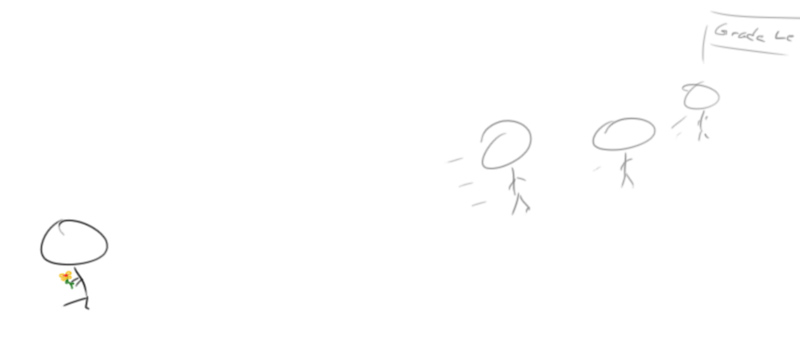
  1. Someone asks your children what grade they are in, and they try to help each other figure it out.
  2. You have a strainer labeled for science, not food.
  3. You have math lessons timed to the length of the dryer cycle.
  4. All your classmates are siblings.
  5. When you send your son off to college and he emails you and tells you that organic chemistry isn't that hard and then gets an A.
  6. You school by the sandpit or snuggling on the bed.
  7. You have to secure all the flashlights in the house because the children will read all night.
  8. Your kids are playing Simon Says with directions like pretend you are an oblique line segment!
  9. The kids' play involves storks on the roof because you just finished reading The Wheel on the School.
  10. When the conversation you are having about middle school chemistry is so in depth that a college sophomore majoring in engineering asks you if you have a degree!
  11. The kids think it's normal to pause movies for impromptu history lessons.
  12. PE is going on a hike in the woods.
  13. Your teenagers love talking things over with their parents and don't mind being seen in public with them.
  14. You use a picnic bench, an oatmeal container, and a hula hoop as a model of the ear canal and eardrum.
  15. Your kids bring pencil and paper on the grocery shopping trip so they can figure math problems as you go down each aisle.
  16. You try to figure out just how many subjects one trip to the grocery store can cover besides math.
  17. You get new pajamas for your back-to-school wardrobe.
  18. Your children get together with their friends to play The Boxcar Children.
  19. When your kids beg to watch TV and then turn on a documentary.
  20. Your daughter wants to have a party and invites seven other homeschool girls to join her in working at the church food closet on a weekday morning.
  21. You're reading to the kids on the bathroom floor while waiting for the toddler to potty.
  22. Your daughter is filling in a blank on a questionnaire that asks, "Where do you go to school?" and she writes, "Under the dining room table."
  23. You sing The Continents Song in the shower.
  24. A snow day means you get to shovel the driveway after you finish your school work.
  25. Your dining table serves as a school desk, a science lab, and an eating surface.
  26. You know what the phrase Box Day means.
  27. Every baking recipe becomes a lesson in fractions and measurements.
  28. You constantly need more bookshelves.
  29. Your son calls out from under a huge fort, "I love this math, Mom!"
  30. Your kids have no idea what grade they're in.

How about you? Do you have a good finish to the sentence "You Know You're a Homeschool When ..."? Leave it in a comment below. Let's keep the humor flowing!

Share this post via email


Submit
Tagged , , | 10 Comments

It's Okay More Homeschoolers Are Behind in School

Share this post via email


Submit
5 Reasons It's Okay More Homeschoolers Are Behind in School

A 2012 study shows that homeschoolers were [at least] twice as likely to report being behind grade level than non-homeschoolers. Statistically, then, as homeschoolers, we're two to three times more likely to be behind than our publicly educated peers.

Wait. What!?

Bear with me a moment because even with these numbers mocking us, I firmly believe you made a good choice to homeschool. Here are five reasons it is okay for homeschoolers to be behind in school.

Continue reading below or listen here:

1. Schools are strange about grade level.

As Sir Ken Robinson points out, we group children by year of manufacture, which is a poor way of doing so. And I'm not really sure how we can claim that so many kids are "on level" when a local school here can fail to teach 84% of 10th graders math. I wouldn't be surprised at all if homeschooled kids had a more robust standard of what it means to be "on level." But even if that isn't the case...

2. Some homeschoolers start because the other systems failed them.

I doubt it's 14% of homeschoolers, but could it be 7%? If so, homeschoolers are right on target and only appear worse off because homeschooling is the only option left. I know some families homeschool because of special needs; of course, I also know homeschoolers who have special needs children in school for the support they receive, so this could be a wash. I don't know, and it doesn't sound like we have enough information to make any kind of statements. So what else is there?

3. Being on grade isn't our focus.

We both know that homeschoolers have strange priorities. One of the differences is that we are a little more comfortable with letting kids learn at their own pace. This is especially true in the younger years. I was way behind in reading for years. Homeschooling let me grow at my own pace. And today, part of how I earn my living is by writing. So being behind just isn't a disastrous thing for us. We don't get government funding based on how well we can shoehorn kids into batches. We focus on the student.

4. Final outcome is what matters, not the moment of observation.

So what if I was behind a few grades in reading? By letting me slip behind, my parents let me excel. And today, after doing just fine transitioning to public school from homeschooling, the fact that I was not on grade level in reading at one point doesn't matter. But there's one more point I'd like to drive home...

5.  Your student is more important than the system.

As homeschoolers, you and I get that. We're homeschooling for our kids. And the study in question demonstrates that religious and structured homeschoolers do great. Sure, we may not always be on level—we may be well ahead for all the data show—but, in the end, we have had great opportunities to be equipped to do whatever God has called us to do. And we have developed a lifelong love of learning while homeschooling with a curriculum we love.

Left-Behind
Left Behind?

So, sure, we homeschoolers may, statistically, be more likely to be behind than their peers. That's fine. There are more important things for us than that.

Learn more about teaching your children at their own pace and on their own level with Sonlight's book-based homeschool programs. Order a complimentary copy of your catalog today.

Share this post via email


Submit
Tagged , , , , | 19 Comments

Seven Reasons to Study History (Rather Than Social Studies)

Share this post via email


Submit

Social Studies is a common core subject in schools. It is an easy subject to add to a lesson plan and teach when you have time, but I don't believe it is an effective way to learn. Discover why children need to study History rather than social studies.

Continue reading
Share this post via email


Submit
Tagged , , , | 7 Comments

Can you combine Sonlight and another homeschool approach?

Share this post via email


Submit
Can you combine Sonlight and another homeschool approach?

What if you love literature-based learning and Charlotte Mason, unit studies, classical homeschooling, or another homeschool approach? Can you combine Sonlight with one of those styles?

In most cases, I would say absolutely yes. Families from a wide range of homeschool philosophies use and love Sonlight.

You certainly don't need to combine Sonlight with another homeschool style unless you want to. That's because Sonlight is a robust homeschool approach in its own right.

Sonlight's unique approach to homeschooling is to provide Christ-centered, literature-based, globally-focused curriculum that helps families love learning together. We emphasize families' reading and discussing together.

1. Sonlight is definitely complete on its own.

It's a broad program that covers all aspects of what your kids need to learn. We schedule it all out for you. Every day you can get up and know what you're going to do.

2. But I also liken Sonlight to a Thanksgiving feast.

You don't have to eat every dish offered on the table. Your children will get a fabulous education from Sonlight as their stand-alone curriculum. Or if you prefer, you can give them a fabulous education using Sonlight as your primary curriculum while adding in your favorite aspects of other homeschool approaches. It's really up to your personal preference and whether you want to spend time tweaking and planning activities.

If you're already hooked on a particular approach, let's look at some possibilities:

Charlotte Mason + Sonlight

Sonlight draws heavily from Charlotte Mason's ideas (as well as those of Dr. Ruth Beechick). Sonlight already provides fantastic living books and plenty of hands-on Science activities. You can easily add in nature walks, extra narration, and other aspects of Charlotte Mason's approach. I encourage you to read a post from Robert, one of Sonlight's curriculum developers, on combining Sonlight and Charlotte Mason.

Montessori education + Sonlight

Some families love the environment and spontaneity of Montessori learning. Although Sonlight would not be a full-fledged Montessori experience, you can definitely incorporate key aspects of it into your day. In fact, Sonlight's preschool programs already draw from Montessori approaches in our purposeful developmental activities. Our Science programs and many of our Math programs also rely heavily on hands-on activities. You can easily add in extra Montessori activities and structures if you like.

Pairing Sonlight with another homeschool philosophy • After studying ancient Crete, Sonlight students Dakota and Skye B take a break to imitate Cretan fresco painting.

Unit studies + Sonlight

Sonlight does not plan out unit studies for you, but we do provide the flexibility for you to add in your own unit studies throughout the year if you wish. I think it's crucial to have a cohesive curriculum (such as Sonlight) to provide a foundation for your homeschool. But if you want to take on additional adventures and mix in some unit studies along the way, go for it!

Some Sonlight families stretch out each History / Bible / Literature program over one and a half or two years instead of one, giving them time to add in a unit study when something really piques their interest. Also, some families like to think of Sonlight's unique History / Bible / Literature F: Eastern Hemisphere program as a unit study approach to a fascinating part of the world.

Classical homeschooling + Sonlight

Sonlight does not follow a four-year chronological history cycle (find out why), but some Sonlight families definitely add in aspects of classical homeschooling. You can easily include Latin, extra grammar studies, and memorization in your school days if you wish.

Homeschool co-ops + Sonlight

Sonlight also pairs well with homeschool co-ops. Think of Sonlight as your primary curriculum and the co-op as supplemental enrichment. A co-op can let you get out of the house one day a week and explore something new. Whether or not your History / Bible / Literature studies line up with the topics in your co-op, I don't think any learning ever goes to waste.

Structured homeschooling

Many homeschool moms love structure in their homeschool days. A daily schedule helps them feel confident that they're doing what they need to. With Sonlight, your Instructor's Guide can take you through every activity each day. You get to check things off as you finish. We have it all planned out so you can just follow along.

Relaxed homeschooling + Sonlight

Perhaps the thought of a strict schedule makes you squirm. Fortunately, many Sonlight families use Sonlight in a very relaxed style as well. The Instructor's Guide is not their taskmaster, but instead provides great suggestions of what to do next. They can easily take an impromptu field trip and just pick up the next day where they left off. They can move ahead in subjects their children find fascinating, and take their time with other subjects.

In short, Sonlight offers you lots of structure, but you can easily make it as flexible as you want. As you grow confident in your homeschool abilities, you can add in whatever extras you'd like and adapt Sonlight to work the way you want it to for your unique family.

But if you love any of the approaches above, know that other Sonlight families do as well and easily adapt Sonlight to their needs. The Sonlight Connections App is full of great ideas on these topics. I'd also encourage you to chat with a Sonlight Homeschool Advisor at no charge. An experienced Sonlight mom can answer your questions, help you brainstorm, and encourage you with no obligation or pressure.

Share this post via email


Submit
Tagged , , , | 1 Comment