When you homeschool, your children learn more than you ever thought they could. And the reality is that even when kids love to learn, it is sometimes hard for them. And homeschooling itself is not always a walk in the park for the parents either.
But we hope that when homeschooling is hard, it is for the inevitable reason that you are an imperfect parent raising imperfect children and guiding them through the process of growing up to become loving, fully functioning adults.
Legitimate Reasons Homeschooling is Hard
In other words, homeschooling sometimes feels hard for various valid reasons:
You and your children are human. You all have room to grow in character, love, patience, and understanding of each other.
Your children are constantly learning how to listen, how to obey, and what is and is not appropriate. Loving and wise discipline is definitely not always easy.
Homeschooling is a worthy endeavor, and any worthy endeavor for God’s Kingdom is going to be a target for the enemy’s attacks. Satan does not want you to thrive in homeschooling as you raise your children to be equipped to do whatever God calls them to do. So of course, he will try to discourage you.
No matter what curriculum you use, your family still needs to eat, you all need clean clothes, and someone must earn money to pay the bills. Much of the difficulty of homeschooling is simply an extension of the difficulty of life. Raising children brings so much joy and laughter … and drives us to our knees to ask for wisdom and strength for the task.
Reasons Homeschooling Shouldn't be Hard
But there are also some common homeschool headaches that are quite unnecessary and can be avoided:
You have to figure out what to teach.
Your children are bored to tears and therefore climbing the walls or just shutting down.
You have to comb through the library to locate books that might possibly be good.
You are sacrificing much-needed sleep in order to plan your lessons.
You don’t know what to do with your homeschool materials.
You are scrambling to find random supplies so you can finally do a science experiment.
You don’t know what’s important to teach, so you live with constant anxiety that you are failing your children.
With the right curriculum choice, these burdens are eliminated. Here at Sonlight, we DON’T want you to struggle for any of those reasons. We want to take on the burden of optimizing curriculum so that you don’t have to.
We want you and your family to love your homeschool. We want you to feel confident and equipped. We want you to pull out your binders and say “I can do this! I have what I need to succeed.”
That’s the whole point of complete Sonlight packages. We take on the stress of creating curriculum and gathering materials, so you can just open up and do what you do best—interacting with your children.
We do everything we can to make Sonlight easy to use so that while homeschooling may sometimes be hard in the ways it should be hard, it's never hard for the avoidablereasons that come with a frustrating curriculum choice.
My dad had a lot of great advice and wisdom. One of the many things I learned from him was the art of giving gifts to children. I remember it clearly. At that time I had three little boys, and Dad and I were standing in his workshop. While he was crafting something, I was holding tools for him. I commented that he and Mom always gave such great gifts to the kids. I told him how many of the moms at my women’s Bible Study were lamenting the amount of toy junk their children receive as gifts for various holidays and birthdays. They wanted ways to curb the toys and limit the junk.
Dad said, "You have to give kids tools, not toys."
That was the advice. He didn't really elaborate—which was unusual because he generally elaborated on everything.
Tools, Not Toys.
Dad is right, of course.
The reasoning is that we are raising kids to be well adjusted, functioning adults who will one day hold jobs, have families, and be responsible citizens. During the short time we have our children under our care, we prepare them to take their place in society. So they need to learn a lot along the way. They need to be molded and shaped and directed. They need the tools—we need the tools—to get them there.
My Dad was a history and shop teacher when I was growing up, and one thing he instilled in us from a young age is, "You have to have the right tool for the job." He would sometimes shake his head during my early married life when he looked at my husband's tools. Many times he would loan us the correct tool for the job. I mean, you cannot fix plumbing without a pipe wrench or work with electricity without a volt tester.
The same is true with kids. What kids need are tools, not toys. If folks could just get a handle on that, the junk found in the kid's section of most stores would be reduced by half or maybe even 90%. But, what is a tool?
Now that I have two toddling granddaughters, I have put together a list of sorts so that my husband I don’t become grandparents who give our sweet grandgirls junk and so that we don't give their parents the stress that comes along with it.
Tools for Kids
sports equipment—balls, mitts, bats, orange cones to mark off goals, etc.
blocks
dolls
small animal figures
musical instruments
flashlights
sandbox
wagon
bike
swings
picnic table
paper, markers/crayons, and scissors
construction blocks
games
backpack
fishing pole
compass
pocket knife
mess kit and other camping supplies
books
a screwdriver and hammer
wood-burning set
knitting, crochet, or any kind of handwork
magnifying glass
leathercraft tools and supplies
jump-rope
pogo-stick
baking and cooking utensils
puzzles
paddle ball
a big empty box
capes, hats, and costumes
gardening tools such as a shovel, a pail, and gloves
Tools encourage imagination and creativity. They often get kids outside where they can develop both large and small muscle groups. Tools stand the test of time and can usually be passed down from child to child in a family. Tools merge the best parts of both recreation and learning. Kids rarely get bored with tools.
When I helped Amy Lykosh develop Sonlight's Preschool Program, I relied on my belief that kids need tools, not toys. Together, we selected a great collection of tools for preschoolers.
Toys for Kids
So what is a toy? Here are some tell-tale signs that you are dealing with a toy instead of a tool.
anything that has batteries and makes noise
something meant for the child to watch rather than interact with
anything made of cheap plastic which breaks easily
stuffed things that talk and/or entertain
Simply browse the children's section of any big box store. Most everything there falls into the toy category instead of the tool category.
Of course, I am not saying, "No toys ever!" What I am saying is that tools should be a child's main diet, and toys should be like a dessert. Dessert is nice, but you have it only occasionally, not at every meal.
So, the next time you want to give a child a gift, remember my dad's words and nourish creativity with tools, not toys.
Regardless of your children's ages, you probably have overarching reasons to homeschool: teaching your faith to your kids, freedom to travel, meeting special learning needs, etc. But today I'd love to offer some specific reasons to homeschool at the various stages along the way. Whether your oldest is three or sixteen, here's a little encouragement to keep at it if you are already homeschooling or to take the plunge if you aren't homeschooling yet.
3 Reasons to Homeschool During Preschool
1. Give your children what they need in preschool
Preschoolers don't need worksheets and flashcards in order to be ready for academic success. In fact, too much seat work at this age can squash children's innate love of learning or even convince them that they are unintelligent. The two most important things preschoolers really need for later academic success is time for free play, and loving parents who read and talk with them. You can definitely provide those things at home! While traditional preschools continue to push academics earlier and earlier, you can give your little ones freedom to discover that learning is exciting.
2. Enjoy a gentle entry point to homeschooling
Are you curious about homeschooling but intimidated by the thought? Preschool is the perfect place to start. If you can read, talk, and play with your child, you can homeschool preschool. So what do you have to lose? Test the waters and see how it goes for your family. I have a feeling you'll love it.
3. Family bonding
These are such precious years with your little ones. As you homeschool the Sonlight way, you will develop rhythms of reading, cuddling, talking, and creating that lay the foundation for a deepening relationship for years to come.
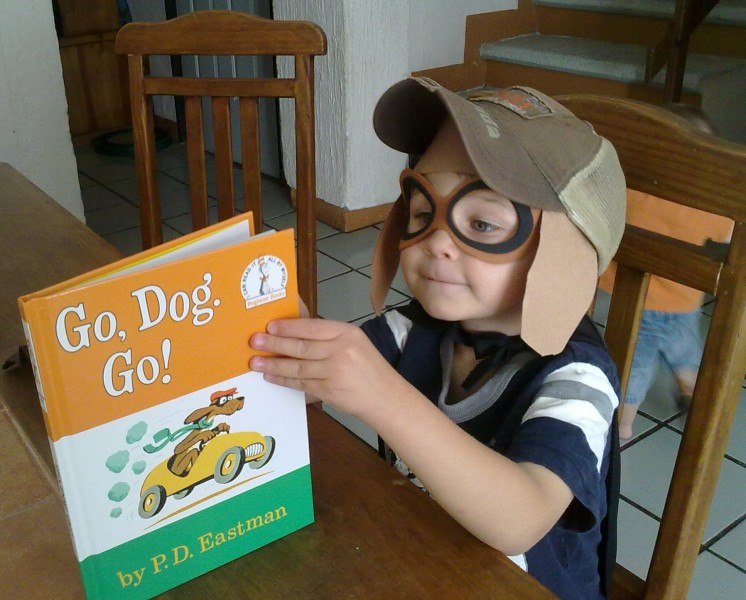
As a homeschooler, Sonlight student Caleb S has freedom to be himself and get excited about learning. So naturally, he dons his puppy dog hat as he explores a classic book about dogs.
3 Reasons to Homeschool During Early Elementary
1. Let your kids develop on their natural timeline
Research confirms that it is unhelpful to push children to read before they are ready. (What it does instead is bring lots of tears, frustration, and labeling!) Most kids who learn to read at age seven easily catch up to those who have been reading since age three. So protect your child's love of learning and let them develop on their own timeline–something which can be all but impossible in a traditional school.
2. Watch the light bulb go on for reading
When your child is ready to read, you get to experience one of the highlights of homeschooling. There is nothing else like the joy of introducing your children to the amazing world of literacy. You get to open doors for them that will facilitate wonder and discovery for the rest of their lives. I still get goose bumps when I think of how precious it was to sit on the couch with my kids and watch each of them gradually take off with reading.
3. Let your little kids act like little kids
Little children don't need to learn to sit still for hours on end, with only a short recess squeezed in. God created them with bundles of energy, curiosity and joy. You can give your kids outlets for all that at home. Does your son want to practice his math facts while he jumps on the trampoline in his Superman costume? Great! Be thankful he can get his energy out in acceptable ways instead of being disciplined in school for not sitting still.
3 Reasons to Homeschool During Late Elementary
1. If things are going well, why stop?
If homeschooling during preschool and the early grades has worked for you, why send your kids to school now? If you just need to tweak some things, give our homeschool Advisors a call at no charge–they'll help you brainstorm solutions.
2. Give your children the time for free play and physical activity that they need
Children absolutely need physical movement and free play in order to learn and develop to their capacity. Schools know this, but feel like their hands are tied ... and so by late elementary (and often earlier), recesses have been drastically shortened. Kids spend most of every day sitting quietly in chairs. Homeschooling gives your children the freedom to learn how God intended them to learn at this stage.
1. Give your children freedom from the immense social pressure at middle schools
Middle school can be the hardest time socially for many children. In these years more than any other, there is incredible social pressure for children to walk in lockstep with each other. The social emphasis is on conformity, conformity, conformity. Homeschooling can spare your children from pressures that they aren't yet mature enough to handle.
2. Protect your children's sense of self
Does your son wear funky clothes? Does your daughter love astronomy and math? Homeschooling in middle school can go a long way toward allowing your kids to continue to develop as their own people, with their own interests.
3. Give them tools to deal with social pressures
Some studies show that girls' self-esteem often plummets in middle school. I don't have data to back this up, but it seems like many homeschooled girls are spared this trauma. Free to be themselves without the fear of ridicule, they can continue to focus on learning as they also develop the emotional maturity they need for life.
3 Reasons to Homeschool During High School
1. Reap the rewards of all you've done so far and savor your last years at home together
You've spent years reading and talking with your children, guiding them through their education. Now you get to reap the rewards of all that hard work! As your high schooler matures into an independent thinker, get a front row seat to hear his or her thoughts and questions. Many parents who homeschool through high school are amazed at the quality of relationship they enjoy with their teens.
2. Tailor their education and extracurricular activities to their needs and desires
Now more than ever, you can tailor your children's education to their own interests and needs. With the amazing resources available through co-ops, college classes, online resources, and teach-yourself programs (such as Apologia for upper level Science), you can help your child soar, even if you don't understand Calculus yourself. You can focus on a STEM track (Science, Technology, Engineering and Mathematics), let them dive deep into music theory, or track down electives that develop their talents. Homeschoolers often have significantly more academic freedom to pursue their interests than traditional students do.
3. Give them more time to experience the real world
Many parents worry about their child missing the "real world" experiences of prom, football games and pep rallies. But I think homeschooling high school can offer more time for them to engage in the actual real world (instead of the relatively artificial world of hundreds of teens confined in one building together day after day). Your child will have time to pursue enriching outside activities to discover what she likes:
volunteering at the local pet shelter
serving as a mother's helper to a young mom once a week
getting an apprenticeship in the medical field
shadowing professionals in various fields
As much as I love homeschooling, I realize it won't be the best fit for every family at every stage. But if you're on the fence, I pray this quick list will encourage you to consider the benefits of teaching your children at home.
I obviously just brushed the surface here. What would you add to the list?
I have heard that there are a few families who manage a different History / Bible / Literature program for each child, but that would be too much for me with my five children. Instead, my approach to homeschooling multiple children is to combine them by using a single curriculum.
Most students in America are in a single grade, and you can observe the progress when a student moves up each year, such as from first grade to second grade. So it may be a new concept for a parent to allow several children on varying levels to work together with a single program.
The easiest way I can explain how I combine my children is to talk about table subjects and couch subjects. These categories might be a little blurry (just where do Science experiments fall?!), but overall, you can picture which subjects you do at the table and which you do on the couch.
You do reading and discussing on the couch. Of course, depending on your day, your couch may be a waiting room bench, a seat on a bus, or a picnic blanket at the park. Couch subjects are portable and cozy.
You do subjects that require a pencil—math, handwriting, spelling—at a table.
Combining Children with Couch Subjects
You combine children only in the couch subjects. So when you read the History books and the beautiful stories in Read-Alouds, you can do that with a range of ages.
These books are satisfying even for children a few years apart in age. To use an extreme example, Go, Dog. Go! from Preschool still thrills me every time (“It’s a dog party! A big dog party!”) . . . and I am a good three decades past the target audience.
But I don’t have to use such an extreme example. If you’ve ever had your 8-year-old come over to hear you read a picture book to a younger sibling, you’ve seen this at play. The Sonlight History and Read-Alouds are not restricted to a single age. And though the readings do get longer as the children get older, they are satisfying to a range of ages.
Similarly with Science, you can combine multiple ages especially in elementary school. The elementary Science programs are quite interchangeable, and if you suspect that Science might not be a priority, feel free to do just one program for all your elementary students. Really.
Teaching Children Individually with Table Subjects
As far as the table subjects—Math, Reading, Writing, Handwriting and Spelling—each child gets material at his or her own skill level to work through, progressing at an individual pace.
There is a limit to how well combining works, of course. Many families choose not to combine children more than about two years apart in age. That makes a lot of sense—there are developmental things going on that can make combining a challenge.
For my family, I actually went through World History with all my boys combined, a six year spread of ages. In order to make this work, I read all the Readers aloud, and kept my older boys supplied with additional books to read instead of the Readers. None of my boys are particularly sensitive, so I wasn’t worried about introducing WWII, say, to young ones; I doubt my youngest has much memory of the WWII books anyway. I made sure to read all the lower-level books to the younger boys, as well, and then, when the older two boys moved into independent work, I had my third and fourth sons working together on the couch subjects, with the fifth waiting in the wings, listening as he chooses.
If you don’t know exactly what will work, you can make an appointment to talk to an Advisor. These experienced homeschooling moms can suggest a direction for combining your children with a single program.
Ready to start the new homeschool year? Consider these 7 questions that can help you evaluate your last year and plan the upcoming one.
The buzz about choosing new curriculum for the next school year is already around me, tempting me into the world of All Things New and Shiny. Meanwhile, I'm just trying to make sure we finish the math books by June!
Although the thought of new books makes me giddy, finishing a school year and planning for the next one can feel overwhelming. Everything sounds exciting. How do you wade through the myriad of options to make a good curriculum decision?
Before you enter a buying frenzy, I encourage you to take a few moments to reflect on this past school year. Looking back to look ahead is always helpful as you set new goals.
Make sure you plan for the school year you actually want to have. Here are 7 key questions to help with planning your homeschool year:
If you find yourself, or your kids, dreading school time, it might be time for a change. Homeschooling should be engaging, not exhausting.
Not enjoying your current curriculum? Consider switching. Sonlight is designed to make you and your children fall in love with learning. We choose books that engage the whole family and make kids want to keep learning. When literature-rich curriculum captures their imagination, children naturally want to go back for more, and that's when real learning happens.
2. Are You Making Progress in Your Homeschool Year?
When planning your homeschool year, you need to know your child's progress so you can approach the year ahead in the best way. You can monitor growth through several important markers:
Observe your children's work from the beginning of the year compared to now.
Have conversations with your children about what they are learning.
Take a standardized test (though those tests are often not he best markers of what a child has learned).
Celebrate other milestones like completing a challenging book independently or showing increased confidence in a subject.
3. What Have You Learned About Your Children's Learning Styles?
How do they seem to take in information and remember it? What motivates them?
Understanding how each child learns best is crucial when planning your homeschool year. Some children are visual learners, while others are auditory or kinesthetic learners. Identifying these preferences helps you choose curriculum and teaching methods that work with your child's natural strengths.
4. Where Did Your Children Excel This Year?
While planning your homeschool year, ask yourself: How can you build on these areas and maximize them?
Recognizing and celebrating your children's strengths helps you plan strategically for the year ahead. Did your daughter devour every history book? Consider adding more biographical reading. Did your son show aptitude in science experiments? Look for ways to expand hands-on learning. Building on strengths creates confident, motivated learners.
Consider creating a memory book to document and celebrate these achievements throughout the year. This can act as a great keepsake and a progress/strengths tracker.
5. What Are Your Children's Growth Areas?
Where did they struggle? What resources can you bring in to alleviate and help?
Every child has areas where learning feels harder. The key is being proactive in providing the right support as you plan your homeschool curriculum. Understanding why a child struggles helps you select targeted resources, adjust your teaching methods, or bring in outside help. Addressing growth areas early prevents small challenges from becoming major obstacles.
6. How Much Independence Are Your Students Ready For?
What level of independence are your students ready for as they study? Who needs the most attention? Which subjects require more one-on-one help? Do you need to make some adjustments to your schedule to make the days flow more smoothly?
As children grow, their needs change—and they can typically handle more independent work as they mature. A third-grader who needed constant supervision may be ready for some self-directed learning by fifth grade. Assessing each child's readiness for independence helps you allocate your time wisely when planning your homeschool schedule, especially if you're teaching multiple grade levels.
Consider which subjects naturally lend themselves to independent work and which require more direct instruction. Rearranging your schedule to match these needs can transform chaotic days into smooth, productive ones.
7. What Are Your Top 3-5 Goals for Homeschool Planning?
If you could pick 3-5 areas to focus on this year, what would those be? They may address academics, character, experiences, or other forms of growth.
Think about each child and consider what they need most next year, socially, spiritually, academically, etc. How can you plan your year to prioritize those specific goals? When you clarify your top priorities, you can plan your homeschool year to specifically support those goals rather than trying to do everything at once.
Need help considering your homeschool goals and mission? Check out the recordings from the 2025 Homeschool Choices Made Easy Webinar, where we explored how to set initial goals and make choices that respect those goals.
Once you've taken some time to reflect, grab your spouse and spend some time thanking God for what He has done in your family over the last year, and make goals for your new year. When my husband and I discuss this each year, it usually involves ice cream late at night, so we look forward to these Very Official Meetings.
Pray for your family and the opportunity you have to invest in your children. Then start looking for the curriculum that fits your learning/teaching style, values, and goals.
What careers would you expect Sonlight students to choose? With a literature-rich curriculum, would you expect them to become missionaries, business people, pastors, or homemakers? Well, many certainly do. But that’s only the tip of the iceberg. A literature-based homeschool curriculum prepares students for STEM careers as well!
If you haven’t already, check out the 2017 Sonlight Scholarship Winners. The way it worked out this year (and every year is different), the top applicants are almost all headed into STEM (Science, Technology, Engineering and Mathematics) careers. Medicine isn’t usually included in the STEM classification (though it’s clearly reliant on math and science), but four of the winners plan to pursue medical training. Seven other winners plan to head into electrical and mechanical engineering, neuroscience research, biology or chemistry. Phew!
So how did these students who grew up on great literature find their way into left-brain fields? As I’ve said for years, a well-rounded education prepares students for whatever God calls them to. Consider a few of the advantages these Sonlight students have as they head into college with a literature-rich homeschool education:
They love to learn and are insatiably curious.
This inner drive for knowledge is critical to success as a scientist, technologist, engineer or mathematician. They’ll encounter many setbacks in their research and study; therefore, they’ll need a lot of internal motivation to learn for the sake of learning.
They know how to identify biases.
All writing comes from a bias, even scientific writing. Though scientists often feel they are completely objective, everything from funding sources to worldviews can influence their work. Far better to be aware of this than to proceed in ignorance.
They have extensive background knowledge.
This background knowledge adds context to whatever they’re studying. These Sonlight students understand so much about how the world works. That provides a framework in which to plug in new concepts and knowledge.
They understand the limits of science.
Sonlight students know that this highly intricate universe has a Creator. While humans can learn and make scientific advances, we will never become God through scientific study. Instead, we can use science, technology, engineering and math to support the work of bringing God’s kingdom of love, truth and healing to the world.
They have an excellent vocabulary.
Developed through years of extensive and varied reading, this advanced vocabulary helps them excel on college entrance tests and comprehend high level concepts.
They have developed imagination.
Creativity is crucial to designing new solutions and new uses for old ideas. Workers in the STEM fields have to tackle problems with no known solution. The expansive education that Sonlight provides from preschool through high school trains students to think for themselves and brainstorm new ideas.
They know how to communicate.
A big part of a successful career in math, technology, science or engineering is the ability to actually communicate with other people. The ability to write a cohesive paper, speak in public, and break difficult concepts down into easy-to-understand language is a huge advantage to young people in STEM fields although it is part of the job that many hopeful scientists overlook. Sonlight students have read and written so much by the time they graduate, they have a huge leg up on their competition.
They have the perspective they need.
The humanities anchor a STEM scholar, making him or her aware of the implications of past work and present discovery. This perspective is a critical need in our world today.
Of course, these Sonlight students have had top-notch STEM preparation as well. Sonlight offers the best of the best in Math programs, from basic arithmetic through calculus. Sonlight Science programs are hands-on, well-loved and rigorous, and our upper-level Apologia offerings include those critical lab science experiences that high schoolers need.
Many of the scholarship winners this year not only completed normal coursework at home, but they also sought out internships, job shadowing, real-life projects and community college classes to prepare them for college-level STEM training. The freedom of homeschooling through high school means that you can tailor your students’ experience to what they want. They can keep up an engaging liberal arts education while also going full steam ahead in the hard sciences.
So if your child is excited about STEM subjects, help him or her dive in and learn more. For more specific ideas of how to support your children considering a career in these fields, check out Forbes’ advice to students or these 10 tips for students hoping to study science or engineering. Your students could even take this short quiz from Florida Polytechnic University to help them discover which fields might suit them best.
I’d also encourage you to just keep homeschooling and know that you will be able to find the upper-level resources you need when you need them. When you feel you might be over your head, consider options such as self-teaching courses (like the upper-level math and science Sonlight provides), community college classes, homeschool co-op resources, internships, paid tutors, and free online resources like Khan Academy. If you’re not ready to teach Physics, Advanced Biology, Trigonometry or Calculus on your own, we’ve got your back.
If your kids are young, keep moving ahead in your studies and helping them love to learn. Know that all your reading and discussion will only help them as they grow, no matter what field they choose. So savor all the Read-Alouds and history. But also enjoy those Mighty Mind puzzles. Move at your children’s own pace as they master math concepts. Break out your science supply kits and give your students the thrill of successful experiments. Let them learn to code, which is also a helpful way to teach bravery!
Whether your students head into ministry, music or nanotechnology, you have what it takes to prepare them well. I count it a great privilege to walk with you in that journey.
Some forms of education rely heavily on memorization. Think of that old rhyme, “In fourteen hundred ninety-two, Columbus sailed the ocean blue.” Columbus is important to history. If you know the date when he sailed, you have a good reference for one of the major transformations of the world.
But Sonlight wants to do more than simply pour facts into your head. When your children think about Columbus, we want them to have some idea not only about when he sailed, or the names of his three ships, but we want your children to have some idea about how the world changed as a result of his travels—big picture thinking.
Using Your Brain Instead of Just Memorizing Facts
As one of the women on our forums wrote:
Retraining our daughter to use her brain instead of just memorizing facts has been a challenge, but what a happy day when she gave her first tentative opinion about the underlying meaning of something that we were reading. She’s no longer phrasing her thoughts as questions, and that alone has made the curriculum and time investment worth it.
I am thrilled to hear when Sonlighters’ children begin to think for themselves.
This excites me, because, besides experiencing the stories, I want our children—yours and mine—to gain discernment and wisdom. I want them to acquire the ability to place current events—and their lives—in the context of world history, so that they can think clearly.
The Old Testament poetically describes some men from Issachar as, “men who understood the times and knew what Israel should do.” That’s the kind of discernment I dream of for the next generation: the ability to see the big picture and see a way forward.
Knowing What to Look Up and Why for Big Picture Thinking
I find it interesting that, quite apart from the Bible, current scholarship on education confirms the benefit of big picture thinking. Since the Internet remains always available to give you any information you might need—the length of the Mayflower, the 47th element on the Periodic Table, the 14th President of the United States, and so on—memorization today is less critical than it was even a generation ago. Today, you are better served knowing what to look up and why—questions that are answered as a result of a big picture perspective—rather than knowing “the answer.”
As you read to your children and talk about the stories, you will see that your children are thinking. They won’t merely know, but they will have ideas about what is right and wrong, about how to love God and love others, about how to live in this world.
I think of a story Shary in Virginia told a few years ago:
I decided—just for fun—to ask my 10-year-old son a review question at the back of a history book we were reading: “What year did Franklin Roosevelt take office?”
There were three choices for answers: 1933, 1903, 1973.
His response: “Well, let's see. The 1920s were when the US was doing really well and people were making lots of money. Then the stock market crashed and we went into the Depression. So it had to have been 1933 when he took office.”
Do I care that he remembered the exact date? No. Do I care that he knew enough of what was going on that he could figure it out? You bet.
She said she knew why her son was able to figure out the answer. It was because he had been using Sonlight.
Because although our signature product is our combination of History, Bible, Literature, a Sonlight education requires students to think, and that is useful in fields that are not related to History or Literature—subjects like Math, Biology, and Engineering.
If you use Sonlight, your children will be equipped for big picture thinking, whatever they are called to do.
If you are ready to find out more about how to train your children to think, Sonlight has homeschool consultants available to talk to you about the next step on your journey. Go here to schedule a complimentary call.