What's the Worst That Could Happen?

Share this post via email


Submit

loveland

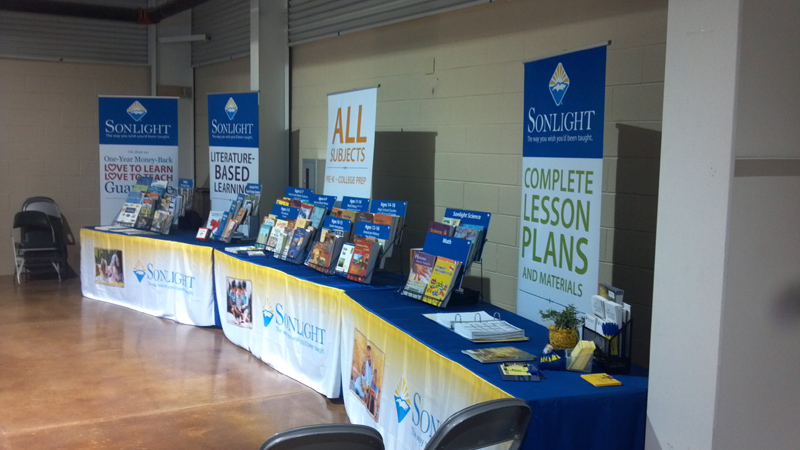
A few days ago I flew to Colorado to represent Sonlight at the Spring Curriculum Fair in Loveland. It was my first of six events for the season. I had been to the Loveland conference several other years, but this was the first time I traveled there alone. Other years my husband had done the driving and we made a family road trip out of it. This year, for various reasons, I decided to fly. Time-wise it was much more efficient to do it that way, but there were many details to think about and plan. Things I usually depend on my husband to do for me.

First, I had to pack up my booth display materials and have them shipped a week in advance. Once I arrived in Denver, I needed to rent a mini-van. After that I had to drive an hour north, find and check into my hotel, and load up the 11 boxes of display materials to take to the convention venue. When I got there I needed to unload and carry in my boxes before I could start setting up my booth. After the convention was over it was time to tear down the booth, repack the boxes, load them back into the van, find the closest FedEx drop-off, unload the boxes again... and the most stressful part? Drive back to the airport, drop off my rental van, and make it through security in time to fly home that night.

Needless to say, it was a nerve-wracking weekend for me. I have a tendency to worry about all the things that could go wrong. What if my boxes didn't make it? What if I got lost? What if I had a flat tire? What if I ran out of time and missed my flight?

But you know what? That kind of thinking is crippling. If I dwelt on all the negative possibilities I would never do anything new or different. I would never go outside of my comfort zone. So every time I found myself worrying about what might go wrong, I would stop and think: "Okay. Suppose that did happen. Then what would I do? What's the Plan B?" Having a contingency plan helped calm me down considerably.

Despite the stress, the weekend went smoothly. I had a lovely time at the convention. I made it back to the airport on Saturday evening with an extra hour to spare. And the experience was good for me.

Last week my daughter had a couple of job interviews that she was nervous about. She was also invited to a friend's house she had never been to about 30 miles away. She needed to drive there alone and it was snowing. So she started worrying... Apparently, the apple doesn't fall far from the tree after all.

In trying to encourage her, I was able to say, "Let me tell you about my experience last weekend..." None of this, "Now, when I was your age..." Isn't it interesting how our comfort zones keep getting stretched all throughout our lives?

 Guess what? My daughter's adventures all went smoothly, too.

There's something very satisfying about doing "hard" things, isn't there?

Enjoying the adventure,
~Karla Cook
Lifelong Learner

Share this post via email


Submit
Tagged , | Leave a comment

From Luke's Inbox: Sonlight and Sex and Swearing

Share this post via email


Submit

I just read the blog post Appalled that I bought utter filth & gave it to my children. She has daughters who are more sensitive than my high school/middle school boys, but this is still disconcerting. I ditch several books a year, but do miss some. Perhaps "questionable content" should be added to the book descriptions online? I give my boys the manual and they take off with it -- I need to be able to trust Sonlight!

I had not yet seen that blog post. Thanks for passing it along. Unfortunately, this blogger and I simply disagree as to what is acceptable and what is not. Sonlight is clearly NOT a good fit for this family. I regularly urge people to read the 27 Reasons NOT to Buy Sonlight article; if you want to avoid offensive content at all costs, Sonlight is not for you. Sonlight carries books that some homeschoolers won't touch. I think we have completely valid and beneficial reasons for doing so. But if you disagree, please find your curriculum elsewhere! As I often say, I'm far more concerned with you loving your homeschool experience than I am with selling you curriculum packages.

We've had a number of requests that we give greater detail as to what "questionable content" means for each title we carry. And some day we may figure out how to do just that. We absolutely want to better serve homeschool families. The difficulty arises when people have such wildly different tolerances. For example, anyone who has attended the high school up the street from my house has already been exposed to even filthier "forms of foul language and sexual content" ...and those words typically came from the mouths of Freshmen trying to prove their "maturity." If we can't be around such things, how can we bring these kids God's grace? Christ was a friend of sinners; may we be the same.

Frankly, the sexual content in Sonlight's titles is hardly shocking if you've read your Bible. What if all the men in a city--young and old--surrounded a house demanding to have sex with the male travelers within? That happens. Twice. Incest? Yep. Not to mention rape, public sexuality, and other despicable things. And these are passages in Scripture! Clearly there is benefit to reading such accounts. So I'm open to there being benefit to reading such things in your homeschool materials as well.

But you know your children better than I do. If they are not yet prepared to handle this kind of thing, please do what is best for them! Sonlight is committed to helping you raise enthusiastic, life-long learners who are motivated to follow God wherever He leads them. But depending on what you mean by the word, you may not be able to "trust" Sonlight. I'm reminded of an oft-quoted passage from Narnia:

"Is he--quite safe?"
"Who said anything about safe? 'Course he isn't safe. But he's good."

If I could be so bold as to draw a comparison: Sonlight's curriculum isn't safe, but I believe it is good.

As always, I'm open to more discussion. Please feel free to share your thoughts! And, remember: You know your children, so do what is best for them. The world is a disconcerting place, full of evil and desperate need. May we be those who, guided by the Holy Spirit, bring Christ's redemption to even the darkest places of the world.

 ~Luke Holzmann
Filmmaker, Writer, Empty Nester
P.S. I have written similar responses to questions about socialism and the occult which you may also be interested to read. Sonlight does things differently, and I believe we are better for it.

Share this post via email


Submit
Tagged , , , , , | 15 Comments

How Presuppositions Control What We Do at Sonlight

Share this post via email


Submit

I got thinking the other day: When I say "I believe in Jesus," what I'm really saying is "I believe He is who He says He is. I choose to align myself with His goals. I am playing on His team."

In other words, what we believe determines—or, at least, it ought to determine—how we act. If it doesn't, we probably don't actually believe it. So I asked myself: At Sonlight, does what we believe determine what we do?

I think it does. It determines everything from the curriculum we create to the way we interact with co-workers.

A foundational belief for us at Sonlight is that God creates people for a purpose. We aren't here to just have fun, be successful and live comfortable lives. I believe we are here to help bring God's Kingdom to earth, through ministering spiritually and physically to this broken, hurting world.

I believe education plays a vital role in that. So I thought I'd share just two of our underlying assumptions about education that determine who we are at Sonlight.

  1. Education should help children develop their gifts and become equipped to do whatever God calls them to do to further His Kingdom.


    Sonlight student Ari J

    This is so dear to my heart. Whenever I join a prayer group at the Sonlight office, they hear me offer the same basic prayer: Lord, may our kids [i.e., all Sonlight kids] be fully equipped and fully prepared for whatever you call them to do.

    Education shouldn't just help kids get good grades and test scores. It should help them become who God created them to be.

    I'm here to tell you I believe homeschooling is an optimal way to bring that about. Parents have the flexibility to help their kids succeed academically – advancing quickly in one subject and going slower in another as needed.

    Homeschooling also gives kids time to explore and follow their talents and interests. With so much more free time than traditionally-schooled students, homeschooled children have time for unstructured free play. They have time to learn computer programming or dive into serious art study. They have time to explore one thing and then move on to another. So often, God uses these interests to guide children into their callings as adults.

    One way Sonlight helps children discover and develop their gifts is through offering so many electives – art, music, computer programming, foreign language, college prep, critical thinking and more. I love what Luke wrote this week about how to help kids follow their interests: give them resources and role models. I completely agree.

    But we don't want kids to develop their gifts just for self-serving purposes. Instead, Sonlight helps spark a passion in your children to seek out what God is calling them to do … and to do it. Our curriculum is full of stories of ordinary people who saw needs around them, followed God's call and ended up transforming their world. I think of Gladys Aylward, David Livingstone, Mary Slessor, William Wilberforce … the list goes on and on. Even fiction characters in Sonlight's programs show kids that they can develop their gifts and do great things.

    Our heart behind Sonlight is to inspire kids who grow up and do great things – not for their own glory, but for the glory of God and the sake of serving real needs in our hurting world.

  2. Every child is naturally curious and can love to learn. Education should help nurture that love to learn.

    Since we believe education should equip children to do whatever God calls them to do, we believe education should also fuel children's natural love to learn. Why?

    Students simply cannot learn everything they need to know before high school graduation; we must give them a love to learn and thus prepare them to be life-long learners. You will never succeed at "force-feeding" a complete education to a child. There is too much to learn in the world!

    If we are to prepare kids for their callings, we must equip them to keep learning after they leave home. If children want to be doctors, missionaries, filmmakers, homeschool parents … whatever their call may be, they will need to keep learning as adults.

    You'll see this presupposition play out at Sonlight through the materials we pick. We don't only find workbooks that teach the minimum so you can check it off your list. Instead, we carefully select books and create a curriculum that helps kids love to learn.

    We want our materials to be colorful, interesting and winsome. Have you read your fellow homeschoolers' Box Day Stories? They're snapshots of the excitement when families receive their new Sonlight homeschool materials. Now, how many companies do you know who provide Box Day experiences like that?

    Sonlight uses very few textbooks. Instead we use compelling stories, we use science experiments and math manipulatives. And this is all done for a purpose. We want to focus in on the fact that kids are curious and love to learn. We don't ever want to beat that out of our kids. We don't want them to get done with school and say I'm never cracking a book again.

    Instead, we want to inspire kids that learning is fun, useful and exciting. Then they'll be ready to keep learning and keep moving toward whatever God is calling them to.

So there you have it – just two of the presuppositions behind who we are at Sonlight. Do you share these assumptions? What core beliefs determine your own approach to life and education? I'd love for you to share with me …

Blessings to you!
Sarita

Share this post via email


Submit
Tagged , | Leave a comment

The Myth of a Standardized Education

Share this post via email


Submit

Her pale blue eyes burn icy cold as she recounts her latest test results. "They changed professors three days before the test. How does that make sense? It's good that they let the other professor go, he wasn't teaching us anything, but they shouldn't have given us our new teacher's test. She actually teaches us stuff, but we hadn't learned any of that yet!"

We are people, not robots. With a robot, we can send a properly coded command and the machine will execute as directed. Make another robot like the first and you'll get the same results. Build a factory to replicate these machines, and you'll get a bunch of uniform actions. This is great for tools like cars and computers and cellphones. But we humans are a tricky bunch. We filter and react to the world differently. And teachers don't teach raw information. Instead, they teach to their test.

This isn't really a problem unless you're hoping to create a standardized education.

In the real world, we need to learn how to adapt to the varying needs of those around us. And with a lifetime of learning ahead of us, we couldn't possibly teach everything there is to know in a few short years. There will be gaps. And if you were to, somehow, create an education that teaches everyone the same material, you'd just have a uniformly ignorant group.

But a standardized education isn't possible. Teachers will emphasize the things they are passionate about and gloss over the elements that seem less important. Classes, not to mention students, will move through the content at different speeds. Let us pretend, for a moment, that we agreed every 4 year old needed to know that 1+1=2. What if a child came to us who didn't know this fact but had already learned to read? What do we do with a child who, like me, couldn't read until well after the "acceptable" time frame? If we decide to cast them off as freaks or failures, we still don't have a standardized education. We have the masses who are "on board" and the outcasts who have been left in the ocean.

If test results change when you get a new teacher with a new test, you don't have a standardized education. The sooner we admit this, the more quickly we can release our students to soar in the life-long journey of learning. Abandon this mad pursuit of a standardized education in favor of the far more useful drive to inspire a life-long love of learning.

As homeschoolers, we're giving our students a non-standard education. Embrace that. The same is true of great professors at top universities around the world.

 ~Luke Holzmann
Filmmaker, Writer, Empty Nester
Share this post via email


Submit
Tagged , | Leave a comment

For God So Loved

Share this post via email


Submit

My husband Dave and I had a very hard conversation last night. We covered a myriad of topics ranging from politics, to missions, to cultural differences, to challenges facing the church.

This just stirred up what I feel God is piercing my heart with right now: His love for people. And last night it struck me, His love for ALL people. Not just the victims. Not just for the ones I want saved. Not just for the downtrodden. All people.

Don't misunderstand me. I started with the downtrodden. I read a gut-wrenching biography as a book preview a few weeks back about a first generation Chinese woman that left me shaken for days. I was deeply disturbed about the cultural things I'd read. I spent that evening crying out to God, shaking my fist at Him wondering where He was.

Where He is for the sex slaves of today. For the orphans. For the deformed. For the child soldiers. For the starving. For the abused.

I am not settled on this issue. God is gripping my heart on these and not letting up. When I am screaming, "How could You!?!" to God, He steadily answers back:

"For God so loved the world, that He gave His only Son, that whosoever believes in Him should not perish, but have everlasting life." John 3:16

Natalia has a CD with this verse put to music and it rolls over and over in my mind. For God so loved the world. The whole world.

For God so loved the rapists of the girl in India. For God so loved the men who splash acid on desperate women. For God so loved those so hungry for power that they would enlist children. For God so loved the abuser...that He gave His only Son. For them. For those that when I start thinking about them, in my heart I rage, they deserve the worst! They deserve worse than death. And yet God longs to bring them to new life. In Him.

How great the Father's love for us. How vast beyond all measure. That He would give His only Son, to make the wretch His treasure.

All of us. Because when God looks at us who have begged for forgiveness, He doesn't see the wrong we've done. He looks at us, covered under the redeeming blood of Christ, and sees people who have been made right with Him. Whatever we've done. My guilt and separation from God were no less than those that my pointing finger cries, "Guilty!" I'm so guilty. If I could truly see my need, I would be astounded by what God has saved me from.

So, as we are in this Easter season, taking time to remember the amazing grace that has drawn us close to our Creator God, I'd love to challenge you to come along with me and plead for many to come to know Him. For the poor, the hurting, the dirty, the unloved. But also the rich, the proud, the angry, the domineering. May it be that in the end, we are able to see how far God's mighty hand has stretched. That we would be able to celebrate that the lost, all the lost, have been found.

For God so loved the world.

For God so loved the world, that He gave His only Son, that whosoever believes in Him should not perish, but have everlasting life.

Until the whole world knows,
Jonelle

Share this post via email


Submit
Tagged , , , | 6 Comments

How to Inspire Kids to Learn on Their Own

Share this post via email


Submit

Last week I wrote about interest-led learning and how having free time gives your children opportunities to discover joy in things that inspire them. Taryn asked me to expand on this with tips for helping children tap into personal interests. I'm certainly not an expert, but I'll gladly share more of my experience:

Your Children Need Resources

Time is, by far, the most important resource for creativity. And, with homeschooling, our children can have that in spades.

Tools come in all shapes, sizes, and styles. Your child may need a set of paints or chisels or pruning sheers or a code compiler. In my case, it was a video camera and some editing software which were, 15 years ago, much harder to procure. I know this can be difficult if you have child like my little brother who jumped from interest to interest. Since we're all on limited budgets, I highly recommend you give your children tools as gifts, not toys. And as online creativity continues to increase, more and more free tools are available. You can find tutorials and classes for just about anything, and free alternatives for many expensive programs. It may, very soon, be worth the money to get the "real deal," but if your children are still exploring all the options available to them, Gimp is a worthy entry to Photoshop, and Blender is an excellent foundation for Maya.

Trust that your kids can succeed. No, they probably won't compose the next world-class symphony at age 4. But if they discover a deep love for music, there's no telling where God will use that gift. My parents let me explore the worlds I was interested in and gave me occasional bits of encouragement. They didn't prod or pry. They simply kept and eye out for things I was passionate about and did their best to give me opportunities to try it out. That paid off. By the time I graduated high school, I had recorded audio dramas, made a couple computer games, recorded a CD with my band, shot a feature length film, built a website, taught myself image editing, and could discuss a wide range of hot topics should a debate arise. Was I any good at any of those things? By no means! But I had a foundation that let me soar in the years to come. My parent's mostly silent support was a huge resource I could draw upon as I started out exploring my interests.

Your Children Need Role Models

One of my uncles helped me write my first Visual Basic computer program. A local repair man helped me build a go-kart from bicycle wheels and a lawnmower's handle bars. My dad helped me craft pinewood derby cars. A friend at church showed me how to work the soundboard for youth group. But I also had fictional role-models, such as Mr. Whittaker from Adventures in Odyssey. Many Sonlight titles introduced me to historical inspiration as well, with people like the Wright Brothers, Robert Fulton, George Washington Carver, and Noah Blake.

My younger sister was inspired by some singer somewhere to pick up the guitar and teach herself a few chords. Of course, we had to have a guitar to do that.

So... give your children a few resources and role models and then encourage them to follow their interests and learn on their own.

How have you inspired your kids to pursue their interests?

 ~Luke Holzmann
Filmmaker, Writer, Empty Nester

Share this post via email


Submit
Tagged , , | 3 Comments

Your Interest-Led Learning

Share this post via email


Submit

I bought a Digital SLR camera a while ago to have one more resource in my film making bag. The minute I got I home, I sat down to learn how to use it and make it a more powerful tool. Pretty soon I was reading about firmware updates, lenses, audio adapters, and other things I'd never encountered before. I was learning because I was interested in making movies using my new camera. In many ways, this was the epitome of "delight directed learning."

This certainly wasn't the first time I'd learned something for fun in my life. I've had similar experiences with computer programming, web development, blogging, media production, debate, scientific study, being in a band, theology, and more. Interest-led learning is one of the most natural ways to pursue knowledge and gain skills.

And, as a homeschooler, I had time to be creative. This left me with many opportunities to participate in interest-led learning.

I still think a more structured educational approach is beneficial as well. We should be stretched and introduced to many things so we can discover even more interests.

And that's where homeschooling is so fantastic: We can experience both formal instruction that fits our educational needs and still have plenty of time to let our interests lead us to learn more.

What things have you--or your children--learned "on your own time"?

 ~Luke Holzmann
Filmmaker, Writer, Empty Nester

Share this post via email


Submit
Tagged , , , , | 4 Comments