Some Distraction or Other

Share this post via email


Submit

A month earlier, World War II had begun with the invasion of Poland by Nazi Germany. Oxford students were shaken by news of the war and confused about how, or even if, they should pursue their studies. On October 22, 1939, C.S. Lewis delivered a message to a gathering of students, offering perspective, insight, and encouragement on the situation.

Available today in The Weight of Glory and Other Addresses, "Learning in War-Time" contains a number of profound remarks. One portion reads as follows: "If we let ourselves, we shall always be waiting for some distraction or other to end before we can really get down to our work. The only people who achieve much are those who want knowledge so badly that they seek it while the conditions are still unfavourable. Favourable conditions never come."

There is much wisdom in these remarks. Life is full of ongoing "distractions"--things that, if we let them, will draw us away from what interests us, what's important to us, and even what God is calling us to accomplish. Sometimes these distractions are mundane and may even be part of our daily routine--surfing the internet, absorbing ourselves in social media, watching television, immersing ourselves in our smartphone, or just having to deal with the daily necessities of life. In other instances, distractions may be larger and more looming--financial pressures, employment transitions, serious health concerns, or a spiritual crisis.

Lewis is not telling us to avoid life or the daunting situations we may find ourselves in, but he reminds us that these sorts of events will always be with us to one extent or another. In short, "some distraction or other" will find its way into our lives (and never at a convenient time). If we wait for the perfect moment of favorable conditions, we'll be waiting a long time.

Homeschooling can be like that--full of "distractions" and detours that life throws our way. Be encouraged in knowing that you're not alone in such circumstances. Know, too, that you can persevere and, despite the difficulties, enjoy teaching, learning, knowing, and understanding.

Robert Velarde
Author/Educator/Philosopher

Share this post via email


Submit
Tagged , , , , , , , | Leave a comment

Chariklo and Why Life-Long Learning Matters

Share this post via email


Submit

One of my friends wasn't feeling well. He was at the ice cream shop he manages when I got the call. "Would you be willing to bring me the bag of lozenges I left on my desk? I'll give you free ice cream."

Free ice cream? I'm so on it. Upon arriving at his desk, there was a bag of branded cough drops, but they didn't have the name "lozenge" anywhere. Did I have the right thing?

Google told me I did. I had never encountered that word before. And I learned something new. I share this as another reminder that there will always be gaps in our education. But there is another reason why life-long learning is so important: There's always more to learn.

Over the weekend we got to talking about astronomy and how Pluto was a planet when we were kids. We were mourning the loss of the ninth planet because we had been talking about 10199 Chariklo. Days earlier, Chariklo became the first minor planet observed with rings. In fact, it doesn't sound like anyone thought it was even possible for a planetary body of that size to have rings. And then we found one.

Chariklo
Chariklo

Put another way, there is no such thing as a complete education. A successful education is one that prepares students for whatever God calls them to do. I think we can say we have been well educated when we have learned how to learn. I think a great education is one that ignites a desire to learn more.

If you're looking for a homeschool curriculum designed to help your children love learning, check out Sonlight. And if you'd like more content to stimulate your brain and potentially introduce you to new stuff, I recommend browsing my Other Posts of Note. Today, I appreciated watching the 40 minute documentary about the Common Core.

 ~Luke Holzmann
Filmmaker, Writer, Guardian

Share this post via email


Submit
Tagged , , , | 1 Comment

Fragile

Share this post via email


Submit

A few weeks back I suddenly found myself being attacked on the Internet. I had posted something on my Facebook page about a personal achievement toward a goal I have about natural living. I got the requisite several "likes" from friends, but then I got something more; a comment from a Facebook friend. A man I attended church with. I'd been to his son's birthday parties. We'd eaten dinner together. And his was not a like.

He attacked me. My morals. My ethics. My intelligence. Repeatedly. Even when I asked him to stop. When I asked him to bring it to a private conversation so the greater world didn't have to see our disagreement. He refused.

I was shocked. I had seen this kind of thing on social media before, but fortunately never experienced it. It was horrible.

I kept thinking, "If I just respond kindly...if I just answer his questions... if I can just turn away wrath with peace...this will all stop. He will see what he is doing and stop. Surely he can see that he is being unfair and abrasive...surely!"

But it didn't stop.

And since it wasn't a conversation, or a discussion, but just a beating of my "wrong" beliefs, I stopped. I deleted the post. I called it off. I "unfriended" my attacker.

But while this happened, before it was done, I broke.

I was at church and a woman who sees me once a week at Bible study came up to me and asked, "Jonelle, are you okay? You look...fragile today."

And I cried. Because I was fragile. Because when people come against you and beat you down, you break. You have cracks and bruises that no matter the original intent, whether truly out of concern for you, or out of a malicious or misguided attitude, remain. As people, we are crushed. We bleed. Internally or externally, people break.

I want to challenge all of us: you, me, everyone, to not break other people. To value them enough that we would not seek to crush or bruise. That we would not take glory from making others into fragile, nearly shattered beings. That we would not need to "win" by having them break to our opinions or our beliefs.

That even if we have the chance to take the knock-out blow that we stay our hands.

Is our opinion worth that? Is our belief worth that? As people who follow One who tells us that the Spirit reveals truth, shouldn't we let Him deliver the piercings of the heart that cause real change?

I don't want to be known as one who crushes, but as one who points to the One who puts people back together.

Until next time,
Jonelle

Share this post via email


Submit
Tagged , | 4 Comments

Why Sonlight Presents Multiple Views on the Origins of the Earth

Share this post via email


Submit

You know that Sonlight presents history from more than one point of view. We believe this is the most accurate and helpful way to study the subject. You know that Sonlight students study different religions. We believe this best equips children to be loving ambassadors for Christ.

Sonlight also presents various views on the origins of the earth. I know this makes some homeschoolers squirm. But I believe this approach is another helpful component of preparing students to be loving ambassadors for Christ.

All Christians believe that God created the world. I believe that is a non-negotiable. But Christians differ in how they believe God created the world. We all believe the Bible is true, but we differ in how we interpret it. I believe our children need to be aware of this reality.

That's why Sonlight chooses to present more than one view about the origins of the earth. We present the leading Christian views (including young-earth and old-earth interpretations) in order to help your children understand and respect what others think. Of course, not all of these views can be true.

So, our approach also helps you teach your children what you believe. When we use a Science book that presents a certain view on the origins of the earth, we provide parent notes to offer counter-arguments to the book's claims. We give parents tools to say: "This is what I believe to be true, and here are some reasons I believe that. But some other people think this, and here's why." I believe that is just a part of good education.

But aren't some of our Science materials written from the perspective of atheistic evolution? Yes, they are. But we often skip the pages in the books that assume an atheistic, old-earth, macro-evolution story. Sometimes we include those pages and provide counter-arguments in the parent notes.

I agree with Luke that it is dangerous to ignore the topic of evolution with your children. If your children go to college they will likely hear a professor teach about how the earth is billions of years old. I don't want that to be the first time they've heard a serious presentation of an old-earth view. I don't want them to think that they must choose between being a Christian and believing in an old earth. I also don't want them to blindly accept the professor's teaching without knowing the reasons why many believe the earth is young.

Sonlight teaches students to think critically. We engage students and help them learn to wrestle through hard topics and sort through the evidence. They come to understand what they believe and why. They learn to dialogue respectfully with people who believe otherwise. I believe this best equips students to serve Christ in the world.

I believe this is education at its finest. What do you think?

Blessings,
Sarita

Share this post via email


Submit
Tagged , , , | Leave a comment

Comfy Pants and Conformity

Share this post via email


Submit

...or, how homeschooling works in suits or sleepwear.

My friends are shocked when they arrive at my home and I'm still wearing jeans. My usual household fare is "comfy pants" -- soft shorts or sweats or pj bottoms -- pretty much anything my wife would urge me not to wear outside. I just don't see the point of chillaxin about my abode in anything not maximally comfortable.

But I always dress up for church (khakis and a button-up shirt). I typically wear a polo and jeans to work. I shower regularly.

And I grew up homeschooling in my pajamas.

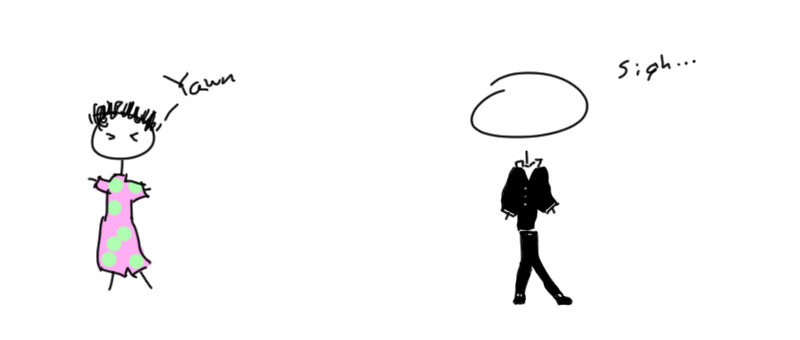
My friend Mrs. C shared about how jammies are the up and coming problem in the homeschooling community. The dozens of comments on the original post are divided. On one side, there are people like me: Dress for the occasion, and the beautiful, flexible, enjoyable part of learning at home is best reflected in comfy sleepwear. On the other side, there are people who find it disrespectful and deleterious to learning to not show up each day in a suit; learning is too valuable to hinder by winging it after rolling out of bed.

PJ-vs-Suit
Which Kind of Homeschooler are You?

If you're "not human" until after you've showered, had coffee, completed a workout, and had a quiet time with the Lord, do it. Dress to the nines and be productive and focused throughout your day.

But I don't have any trouble focusing in comfy pants. In fact, I've been writing and producing videos for years in the most relaxed wear I own. And while I appreciate a shower to help me wake up, I wrote a first draft of a book directly after rolling out of a bed and being blasted by my computer screen's searing blaze on my sleepy eyes. From what I've read, it's more about mindset and habituation than the formality of the fabric covering my legs.

Come over to my house some time. And while we sit around and chat, you can tell me if you think I'm

a) shirking responsibility
b) lazy and not really doing anything
c) just plain weird

Sitting there in my comfy pants, I'll give you a hint: "c" is the correct answer. Homeschoolers are strange. But I was also strange in college. And if you ask me, any guy who can show up to class in a bathrobe and graduate magna cum laude may be really odd, but his choice of clothes aren't hindering his education.

 ~Luke Holzmann
Filmmaker, Writer, Guardian

P.S. I went to college in California, so it was too hot to go to class in sweats and a bathrobe most days. I tended to wear shorts and a t-shirt.

Share this post via email


Submit
Tagged , , , | 2 Comments

The Placebo Effect: Homeschooling Works

Share this post via email


Submit

In Blink, Malcolm Gladwell discusses how asking a student to select a nationality often decreases the student's performance. This is linked to a study that shows students do better on tests if they imagine being a doctor instead of a basketball player. Think about that: Simply imagining you're smart makes you better at tests; associating yourself with underachievement needlessly reduces your ability to perform.

I don't recommend visiting the site to try to diagnose an ailment, but WebMD defines the Placebo Effect as any treatment that does "not contain an active substance meant to affect health." Like the impact of saying I'm "Caucasian" or imagining I could actually jump, the change in test scores has nothing to do with my education. There is no "active substance" meant to affect my knowledge.

But I am affected anyway.

And the effect is real.

Seth Godin just released a fun little document about placebos in marketing (I haven't finished it yet, but it's been interesting thus far). I was surprised to learn that acupuncture, for instance, is more effective than Western medicine at easing back pain. Godin says the impact is real, but still labels acupuncture as a placebo ... partly out of cultural bias, but also because of a fascinating twist in the study!

And perhaps the real impact of placebos sheds light on something I've been thinking about for a few years now. Homeschooling is good choice, but the results aren't statistically superior to any other educational approach you could have selected. But we homeschoolers love homeschooling. It's the best! Our kids a thriving under it.

And we homeschool kids do. We thrive. In large part because we're awesome (and beautiful). Another big factor is that you help your children succeed. But, perhaps -- just maybe -- there's a placebo effect in being active in your student's education.

And if there is, jump all over that!

Because, really, I don't care if there is something actively trying improve my education. I care about what works.

And homeschooling works.

Placebo or no.

 ~Luke Holzmann
Filmmaker, Writer, Guardian

Share this post via email


Submit
Tagged , , | Leave a comment

Trust your gut ...

Share this post via email


Submit

Spring2013_3Spring is on its way in upstate NY ... at least the calendar and the weathermen say it is. I keep looking for the hyacinths that I photographed last spring ... but the snow is still too deep to find them.

Along with spring comes an influx of parents beginning the planning process for the 2014-15 school year. The anticipation and excitement of summer activities is looming on the horizon, yet these committed moms and dads are already planning for August and September school days. Talking with them every spring is one of the most favorite aspects of my job. It is such a joy to talk with folks who have sacrificed much and are so very passionate about their children's education.

A common thread seems to run through many of the conversations I'm having this month. Some parents are concerned that the curriculum choices they're making might be the "wrong" ones, or that they'll somehow handicap their children by not choosing wisely. I remember having those same misgivings as I would choose math and history and science each year.

Might I offer one small piece of advice that I think will reap large dividends? Though not original to me, I regularly tell parents to trust your gut. My Advisor teammates and I can share a wealth of knowledge about our products, and our best recommendations for using them, but you alone are the "expert" on your student(s). While we usually recommend only combining children who are 3-4 years apart in age, if you've come up with a good approach for teaching your 7 year old and your 12 year old together, go for it! While we do not usually recommend beginning with the second Core in a two-year study (i.e. Core C or E or H), if your family is excited about doing a study of American History, beginning with the Civil War, please feel free to begin with Core E and have a wonderful school year learning together!

We are always happy to offer curriculum advice based on our years of experience and product knowledge ... and you can even head over to the Sonlight Forums and glean from the years of experience represented there ... but please always remember, you are the best judge of your student's educational needs. So certainly research, and ask lots of questions, and gain as much information as you can ... but learn to be confident in what you know about your children and how they learn. We might not always agree with your choices, but we will never disagree with the fact that you are the expert where your children are concerned.

Still on the journey,
~Judy Wnuk

PS ... The 2014 Sonlight catalog is in the mail and winging its way towards homes across the globe. Be sure to request yours if you haven't already!

Share this post via email


Submit
Tagged , , | Leave a comment