When you think of what you're grateful for this year, I trust that having the freedom to homeschool makes the list. I know it can be hard when you're in the trenches of day-to-day parenting and teaching. But know that most veteran homeschool moms look back at their time of teaching their children at home with deep gratitude. I know I do.
To encourage you with some long-term perspective, I have a gift for you. We collected stories from moms about why homeschooling their kids has been worth it – worth all the hard work, worth the sacrifices and worth the huge time commitment.
The whole thing came about after a conversation I had with some friends who had also finished their homeschool journeys. We were talking and laughing about how hard it was at times to teach our children. (Like all those days I practically had to sit on Justin to get him to focus on his math!) Then my friend Jill and I broke out at the same time with an emphatic "But it was worth it!"
And it was indeed.
So, we set out to collect people's stories to encourage you during your homeschool journey. To give you just a taste, here's a short excerpt of my chapter, "How Homeschooling Freed My Children to Be Themselves":
In fact, I wouldn't trade my time at home with any of my kids. I firmly believe that homeschooling kept both Luke and Justin from being labeled. I fear Luke would have gotten the message in school that he was unintelligent. In reality, he just had an eye-tracking disorder that it took us far too long to figure out. The mechanics of reading were painstakingly difficult for him. But as I taught him at home, we were able to progress in reading at his own tortoise pace while we raced ahead in our other subjects. I simply read his Science and History out loud to him, and let him dictate his writing assignments to me. In school, his difficulty with reading would have put him behind in all subjects.
Instead, Luke knew reading was hard, but he never once thought he was unintelligent. By the time he started public high school, he had figured out how to work around his difficulties. He graduated valedictorian and went on to pursue a meaningful career in media and film.
I also think that homeschooling protected my youngest son, Justin, from being labeled. ... (Read the rest in the e-book.)
I trust that God will honor your hard work. The time and love you are investing in your children now will bear fruit for years to come. I pray that when your kids are grown, you too will have an inspiring story of why it was all worth it.
God bless you in this great and worthy task of raising and educating children!
Sarita
P.S. As Thanksgiving approaches, I am also incredibly thankful for you! I am so thankful for you and your noble commitment to raise and teach the next generation. Thank you for being part of the Sonlight homeschooling community!
I think a lot about what I want to do for my kids to help them succeed in life. Just recently I was combatting the “I’m not doing enough” feeling and a simple Pinterest browse sent me reeling. As I was scurrying around to provide experiences for my kids, I ran headlong into a truth so simple, it stopped me in my tracks.
As a homeschool alum looking back, I’m shocked to discover that when I think about what made me feel most secure, most thankful for my parents, most fulfilled and happy, it was less about the things my parents did for me or produced (think Pinterest-worthy crafts or perfect unit studies) but their availability and attention.
As a child, I almost took it for granted that of course my parents wanted to hear this new poem I wrote or wanted to come and see the map my brothers and I had created or that they would want to be drawn into a game we just knew everybody in the family would love. Not that they never had moments when they were busy or that they made their world revolve around us, but they listened and were available enough that that was the default. They made us think it was worth it to say "Come see!" "Did you hear ...?" I can't wait to tell you about ….”
This child-like assumption of unconditional love and interest is a great gift we can give our children. When we give the gift of attention, we are modeling selflessness and the art of listening well; we teach our children that though they are not perfect, that they have ideas worth sharing.
My parents directed my learning, sure, but I now appreciate the restraint it required for them to give me time to absorb and produce and process and speak it back to them in the different ways I was inspired, before driving on to the next thing. In that sense, I felt I was active in my own education.
As a parent, however, it’s all too easy for me to slip into production-line mentality. Let’s just get everyone through the right book, the meal, the clean up, the next activity and get through a Successful Day, easily forgetting that life and love and memories are made in the in-betweens.
I remember someone laughing about a phrase I used during a Sonlight Conversations webinar earlier this year when I said that I want to remember that our children are not a herd to be managed but souls to be nurtured. But it’s true that we need that reminder sometimes, right?
In the midst of the busyness of all the things I need to do for my children to give them a good education, I’m reminded that sometimes one of the best gifts I can give them is to be still and listen, watch and ask, and just “be” with them without an agenda.
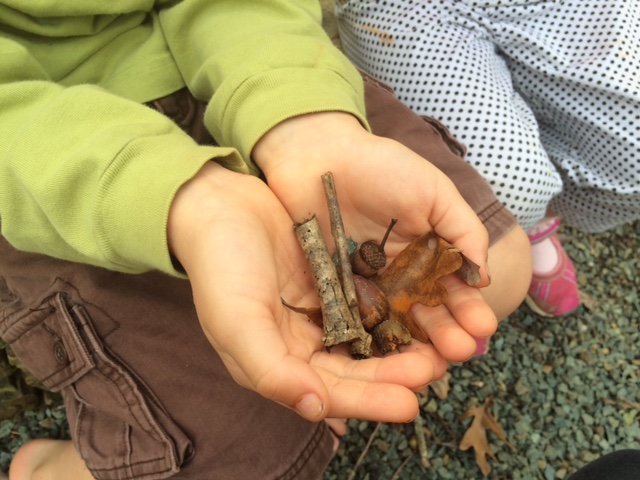
Yes, we need to get through the math book and we need to clean up breakfast, but I am going to take an extra few minutes to look into those eyes, let him finish that story, grab that little hand, absorb it all as he explains the jet propulsion of the Lego ship he just built or she pulls me out back to show me the little pile of acorns and petals she gathered.
The of work of being present doesn’t necessarily give me results to show off on my Facebook page. My children’s creations might sometimes look more like Pinterest Fails than pinnable beauties. However, the act of being present and tuning into my kids teaches me selflessness, it purifies my motives and it’s an investment in their hearts. How I spend my time with my children teaches them volumes about who I believe God created them to be: People of value, people with interesting ideas, people worthy of my best time. I pray they will learn to value, listen to and enjoy other people through my example.
As we are going about the things we need to do, I have to remember to hold these children up as treasured even in the midst of the crazy. As simple as it seems, the gift of my presence is one that will last my children a lifetime.
I'd be negligent not to add that this is one of the things I am most thankful for about a tool like Sonlight: Sonlight helps me make the most of my time together with my children. By its very nature, the curriculum encourages parent-child interaction and discussion, not just a “go do this worksheet” mentality. Having resources like the IG and great literature already hand-picked frees me up to do more of the parts of homeschooling that matter most to me, like spending time cuddled up with my kiddos, making memories.
What are ways you carve out time to just be together in the midst of the every day?
I've wrestled this week with what to write. Nothing profound or inspiring has come to mind, partly due, I'm sure, to being somewhat overwhelmed with life at the moment. As I was reading during my quiet time this morning, it struck me that surely there are others who are swimming in deep waters, and might just find encouragement in what encouraged me.
The faithful love of the Lord never ends! His mercies never cease. Great is his faithfulness; his mercies begin afresh each morning. (Lamentations 3:22-23). The writer of my devotional reading this morning referenced this passage, and then remarked that she finds that worrying gives her the illusion of control ... that a lot of days it feels easier to worry than to trust. She obviously has been spending some time inside my head!
She went on to observe that with all her worrying, the one thing she never frets about is whether or not the sun is going to come up in the morning. And with each new sunrise, God promises fresh, new doses of mercy. It's a sure thing!
I recall talking with my mom shortly after 24 hours of labor and delivery with our oldest daughter. One of my comments to her was something along the line of "no one ever told me how hard this would be." I'm sure she smiled and replied with the quiet wisdom she seemed to always possess. As we went on to have more children, and raise and homeschool them, I recall similar conversations with good friends. "No one ever told us how hard this would be!" On the tail end of that statement we would invariably smile at each other and say "We really should write a book."
It came to me again this morning that while my mother has never written a book with pages and covers, she most definitely has written a book in my life. And I (and you!) are doing the same thing, every day, as we love and raise and parent and teach our children. While this season of life no longer has me actively parenting my children, I am now in the position of "parenting" my parents. It is a difficult and often exhausting season, but I am encouraged that each morning when I awake, there is a fresh supply of mercy waiting for me. And while I doubt that I will ever write that book, if I did, God's mercy would surely be the recurring theme throughout.
Please be encouraged as you start your day today, in whatever season you find yourself ... as sure as the sun rose this morning, God's supply of mercy is brand new for you as well.
The thrill of Box Day had faded, and I was knee-deep in making the school year a reality. I had three students that year; Mary Hannah was 8, Mathaus was 5, and Jack was 3. One was a conscientious, empathetic bookworm who lived for the smell of a horse barn. Another was a curious, hands-on doer. The last was a spunky new preschooler happiest with a pile of building blocks or an easel ready for finger paints. We were ready for an adventure of epic proportions with spiders who spun messages into webs, the birth of Rome, the unearthing of a pharaoh’s tomb, the antics of the fallible, fickle Greek gods.
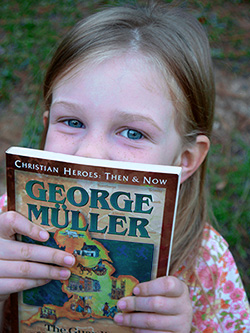
Sandwiched between the dramas of establishing new civilizations, the perils of attempting to appease false gods, and the intrigue of following the arc of classical history was a simple story of a simple man serving the Lord. Flipping through the pages, two things immediately stood out to me: George Müller had lived a breathtaking life … and my kids weren’t really going to be interested in it.
You see, there were other missionary tales in that box, and to be honest, they had much more of a hook. Miraculous escapes. Exotic locales. Man-eating wild animals. These are the things that captivate the elementary set. A guy who prays for bread to feed orphans and has a baker show up? Eh. I mean, it’s cool and all, but what about that cannibalistic river tribe? Now that’s some missionary heroism!
When the IG said it was time, I picked the book from the shelf, heaved a sigh, and began. Each afternoon, the reading seemed to flop. Whether it was the fact that we were still picturing the expanse of China being broken by the building of the Great Wall or the subject matter at hand, I don't know. But what I recall most about George Müller even today were hours spent reminding fidgety children to stop loudly pawing through the Lego bin and to listen, please, guys Just five more minutes, I promise. Unlike most of our history reading, which found children angling for the spots closest to my side, this one seemed to cause us all to grit our teeth and soldier on rather than relish the tale at hand.
We never did fall in love with that book. Unlike some titles that redeem themselves a chapter or two in, George became something like an unwelcome relative in our home; we had to answer the door when he knocked, and we did our duty by him, but our heart was certainly not in the right place. When it was over, there were no bubbly reminisces, no recounting the details to Dad around the dinner table. The book went back into its place on the shelf, and we moved on to bigger, better, more thrilling things.
A month ago— ten years later, if you must know— I again found myself sorting through the books of Core B. This time, I was preparing to teach an 8 year-old with learning challenges, a super-wiggly 7 year-old, and a precocious 5 year-old. My older children— all teenagers now— crowded around, pulling well-loved, dog-eared books from the box and sharing their memories. Detectives in Togas. Charlotte’s Web. Tut’s Mummy. When one of them found the still-pristine copy of George Müller, I gave a little groan.
“Oh, no. They’ll never make it through that one,” I lamented, picturing distracted, disinterested children chomping at the bit to get their teeth into something with more action.
“What?” my 15 year-old asked. “Are you kidding? It’s George Müller! Remember when he prayed for milk, and the dairy cart broke down right in front of the door?”
I do, I thought. I remember it well. You were just about ready to swing from the rafters and … wait a minute. What?
“Yes! And the way he kept track of everything so that he could look back and see how God had met his every need?” the 18 year-old chimed in.
Hold on— you heard that?
“I just remember how he prayed for everything. All the time. And he never asked anyone for a single thing, but God never let him starve—no matter how many kids they had in their homes,” shared the 13 year-old.
“When we started fostering, I thought about him a lot.”
And on and on it went. A retelling now, a decade later, of a life of faith so quiet, so bereft of heart-stopping deeds of bravery, so faithful that it stood out. Written on their hearts, all these years … George Müller, the man who opened his doors to children he couldn’t afford to feed. Right there, in that year so full of pyramids and the Parthenon, my children met a mild follower of Christ who gave them an example to draw on as God guided our family through the journey of faith He had written specifically for us. A decade later, they can still point to reading that book, hearing that testimony as being a time when the beginning foundations to their trust in God was formed.
And I had no idea it was happening.
Later that night, as I shelved books for the upcoming year, I wondered what would have happened if I had decided to give up on George Müller. I wondered what my children would have missed out on if I had followed my own inclination and quietly slipped the book back, pulling out instead something that would have elicited more excitement. I wondered, too, about the books I have skipped over the years. The ones that seemed maybe too mature, or like too much work, or just didn’t strike my fancy. Was a learning opportunity missed? Had God planned on speaking to them— to me— through one of those titles? Had I denied us all a powerful lesson through my own biases or assumptions?
I’ll be reading George Müller again, this time to a new set of squirmy littles. I’ll also be carefully praying over any other books that just don’t seem to be hitting the right note. Maybe I’ll still set them aside. I strongly believe in fitting the curriculum to the family, not vice versa. But maybe I’ll push through anyhow. Because that book we didn’t love? It took root in the hearts of my children and is bearing fruit, even now.
~~~
Heather Mills Schwarzen is the wife of one globe-trotting, church-planting adventurer, and Momma to 9 beautifully messy people who range from toddlers to late teens. She writes about parenting, homeschooling, adoption, special needs, and serving a very big God on the family's blog, To Sow a Seed. You can follow the entire family's adventure in a life of ministry on their Facebook page, or via instagram: https://instagram.com/to_sow_a_seed/.
Don't let me forget to tell you about how wolves change rivers. But first...
I'm on my way home from a family trip. There are nine of us on this flight, so I'm across the aisle from my wife and parents, the window seat open next to me. A friendly looking woman indicates that's her spot. She starts talking almost immediately. She's in education, teaching at a woefully under-funded school in a poorer district of a poorer state. This sounds familiar (like point #3 in this post). I happily engage in her story, looking for insights into the less public side of public education. She mentions her struggles with the Common Core, her frustrations Arne Duncan, her hopes for her students so hindered by their socioeconomic barriers. I interject a little here and there. "Are you a teacher?" she asks. "You've got to be in education because you know a lot about this stuff."
I grin. "I've become an edu-theorist, of sorts. I work for a homeschool curriculum company, blog, and get to read a lot about education."
"Oh," she says half playfully, half menacing, "I'm probably not going to like you."
"Why not?" I ask. "We clearly already agree on a lot of stuff. I'm not against school just because I know that homeschooling is a great option and wish more people took advantage of it."
She's skeptical.
Two hours of non-stop discussion later, she smiled as we parted. We were clearly on the same team, though we disagreed on a few of the specifics of how best to achieve our common aims.
I appreciate these opportunities to interact with people who are not pro-homeschooling. They give me a chance to learn about the latest concerns -- even if they are tired complaints like socialization or awkwardness (which is really the same complaint). The more difficult objections come from those who were homeschooled and had horrific experiences. But I welcome this as well if we use it to improve homeschooling.
I believe it is best to tackle this stuff head-on. That's why I welcome studies that indicate homeschoolers are behind in school. It forces us to re-examine what we are doing, and why. It challenges us -- as homeschoolers -- to consider how we do things, and drives us to improve or solidify our priorities as different. That's all good.
...a bit like how wolves change rivers. Watch the 4 minute video, it's fascinating. The short version: Reintroducing wolves into Yellowstone transformed the ecology in a positive way, even decreasing erosion along the rivers.
You're busy homeschooling, so please don't feel pressure to go out and read negative things about homeschooling. You have plenty of opposition where you are with your own fears, struggles, students, and choices. But next time there's tears -- for you or your children -- I exhort you to think of that situation like a wolf, eating a cute little deer of a dream of perfection and peace, but giving space for other things to grow, like character and grace and a renewed focus on your children.
Your homeschool experience will be better protected against erosion if you let it.
Ask me to teach Science, I'm in my wheelhouse. Ask me to teach Math, I'll go find my husband. Ask me to teach Art? I'll probably chuckle and tell you I had a hard time passing stick figure drawing in first grade. So how in the world did I expect to teach Art to my children. And how important was it, really, to teach them Art anyway?
We've all read the research that demonstrates the value of adding arts to a child's education (even as an infant), but do we agree? A May 2005 Harris Poll on the attitudes of Americans toward arts education, commissioned by Americans for the Arts, revealed (in part) the following:
93% agree the arts are vital to providing a well-rounded education for children
86% agree an arts education encourages and assists in the improvement of a child's attitudes toward school
83% believe that arts education helps teach children to communicate effectively with adults and peers
Knowing Electives are a good thing and actually making them happen are two different things! Motivation is tough to come by if something does not ignite your passion. So how does a busy homeschool mom make sure that those valuable Electives aren't missed?
Plan a specific time(s) in your school schedule each week to work on Electives. I don't know about you, but if it wasn't scheduled/written down, it didn't get done in my house.
Find a "curriculum" or other product that does the planning and decision making for you. If you're not artistic by nature (or musical, or athletic, or computer savvy), then creating art, music, and other elective projects on a regular basis for your students isn't likely to happen.
One of the biggest struggles for me was convincing myself that investing in Art, Music, and other Elective products was just as important as spending hard earned money on Math and Science curriculum. Please let me encourage you that the investment is definitely worth it. As we mention on our web site: Electives help to broaden a child's horizons, Electives help your kids discover their talents/gifts, and Electives add fun and interest to your homeschool ... all of which I found to be true for our family. Piano, flute, karate and computer programming likely wouldn't have surfaced in my kids had I not invested time and money in discovering where their passions were.
If your school year is well under way, but you haven't yet added Art or Computer Programming or a Foreign Language to your weekly schedule, now is the perfect time to do so!
If you haven't see the educational video Don't Stay in School, check it out:
I enjoyed the song. It's catchy, creative, asks some solid questions, and points to frustrations to which millions of people can relate. Myself, included. But even while I watched Dave's excellent response to the comments [NB: language; this is the internet after all], I had this nagging feeling that just wouldn't go away.
Why was I feeling so ... off?
I mean, haven't I linked to videos suggesting that computation isn't the main part of math we need these days? (Why, yes, I have, and I think I've shared this talk as well.) Over the years, I've certainly wrestled with similar questions. What wasn't connecting?
I went home and mulled it over all evening. I got up, still thinking about the theme of "stuff we don't need to know" / "subjects that shouldn't be mandatory" / "all the stuff we never learned that is way more important than stuff your cellphone can do better." Frustrated with my inability to formulate any coherent thoughts, I watched the video again and read the lyrics...
I wasn't taught how to get a job
but I can remember dissecting a frog
And it hit me, like the sinking feeling I get when tax day rolls around each year, unrelenting, grave, and political: You can't avoid this. This problem is inevitable for very specific reasons. What follows is my attempt to unpack those issues from my perspective.
#DontStayInSchool
1. You can't be taught how to get a job.
Seriously. My reason for feeling unsettled by the song was in the very first line: An education does not equal a job. It's just that simple. But why can't you learn to get a job? That is an important question, one I hope I addressed sufficiently in my post.
2. It's easier to introduce concepts and have kids memorize stuff.
Dissecting a frog is relatively easy. Asking kids to memorize the quadratic formula is cake (even easier: give them a bad grade if they don't, and move on).
So while it may have felt like we spent a sufficient amount of time discussing isotopes such that we could have mastered the political system in that time, we didn't. Learning how to vote properly -- whatever that means -- requires way more information, discussion, worldview building, and such when weighed against memorizing how isotopes form.
[By the by, we spent very little time on isotopes when I was at my public high school.]
But the bigger issue is...
3. Your education should not be about indoctrination.
When we bemoan not knowing "how to vote" or "who controls money," we are frustrated by political things with answers that would be highly biased if taught in the same way we teach mental math. This isn't a complex formula you can solve by punching it into your calculator.
In fact, the best way to learn how to vote, in my opinion, is by studying the very things mentioned in the song: Henry the VIII and the Hippocratic Oath. Because, yes, we could discuss politicians and current political issues, but without the history of things like Henry the VIII's break from the church and how modern bioethics connect (or not) with the what Hippocrates formulated, we would quickly make some very poor decisions. [I considered linking to a post about bioethics, but it was too political. You're welcome.]
The short version of this point is this: History helps us make sense of the world. ...and it does so in a way that educates, not indoctrinates. Who of us would rather teachers simply taught kids how to vote? No one. We learn about the flow and control of money by learning about the historical events involving money, and in so doing, we discover how bad things are when governments and corporations and greedy people get their hands on the stuff.
This points us to the fact that...
4. You need background and maturity to tackle really meaningful topics.
You can -- and should -- introduce difficult stuff early (you first encounter WWII in Sonlight's program for 5-7 year-olds). But, honestly, you can't dig into the holocaust, mental illness, your basic human rights, investments and giving, domestic abuse, political change, or even raising children until you have a framework for those things.
If a child is suffering abuse, they have a framework and they should be removed from that situation ... but it's going to take years for them to come to grips with what happened and heal; you will do no better with a kid who has no context for such evil.
With mental illness, yes, we'd love a solution. But looking back on history -- One Flew Over the Cuckoo's Nest, anyone? -- we've come a few paces, but we still have miles to go. Families, let alone schools and politicians, have yet to figure out what to do about it. (I haven't seen the movie, but I'm wondering if Maggie is an artistic approach to tackling these hard questions.)
In other words, while I totally relate to the frustration in the song, these are adult issues that can't be answered even now as adults, let alone as a kid who still can't properly hold a fork.
5. Learning should be specialized/tailored to the student ... somewhat.
Personal example: My mom told each of us kids that we had to learn an instrument; she didn't care which, but we had to choose one. That's how I started playing the trumpet. I had freedom -- but, really, did I have any idea what instrument to choose? no -- but I was still required to choose something from a particular category.
Why?
Because music instruction is good for you. Same with math, history, science, handwriting, and even foreign language.
The difficulty is in determining how much. And this is probably the point of most connection for everyone who has enjoyed this song: We also feel like we spent too much time on x at the cost of missing out on y.
But I wonder: How much of that is our own personal bias? Put another way, what things would we discover we like if we we were to be forced to try them? How long must you work at something difficult before you discover the pleasure in mastering it?
So, sure, we may spend too much time pushing kids who don't write well to diagram sentences, and we may have wasted many hours insisting math-phobes memorize their times tables ... but, given the right mix of nudging and investment, even kids who hated math or writing can end up top of their class in English or Calculus. (I just interviewed a mom whose child did exactly that.)
Have we sometimes gotten the balance wrong? Certainly. But I don't think that means such subjects shouldn't be in school. And it's certainly not insane. It is ironic, however, that this very problem shows up as something Dave seems to want changed...
6. We need not follow the rest of the world
... in foreign language or otherwise. There is a very good reason people outside the US tend to know at least two languages: They often learn English. Why? So they can communicate with English-speakers.
How did English become the language of commerce? There's some very interesting history on that, but the fact remains: America -- and the UK? -- doesn't feel pressure to push a second language because there is no such pressure.
The high school and college foreign language requirements are built upon the same foundation as what I've argued above... it's good for you.
But my study of Spanish, while useful in some areas, hasn't stuck with me because I simply don't need it. So while Dave wishes he kept up with the rest of the world in this subject area, I don't see a benefit to investing that much time into mastering that subject. And isn't that the very point of his video?
What now?
7. We should once again look at the purpose of education.
My childhood wasn't wasted. I was educated. Yes, even while in a public high school. Did I go through some pointless exercises? Yes, even in college, while pursuing my personally selected major.
...all that to say...
I appreciate the frustration. I resonate with the critique. But upon further investigation, I don't think the complaint holds water.
Can we do a better job deciding what to teach when and for how long?
Probably.
We homeschoolers have that opportunity uniquely open to us.
But even with that freedom, I'd still recommend at least touching on history, science, literature, math, handwriting, etc... because these subjects provide the foundation upon which we can understand and learn about the bigger issues in our world, like politics, mental health, parenting, first aid, investment, and more. As I argue, that's the entire reason to get an education.
I am interested to find out what he ends up doing, and what impact that makes. He's certainly struck a nerve and I hope it leads to improvement in schools and education in general.