From Luke's Inbox: Teen Depression and Suicide

Share this post via email


Submit

This article expresses why we didn't purchase Sonlight past 7th grade. I'm not sure how titles like Brave New World, The Great Gatsby, Treasure Island, Death of a Salesman, and others line up with Philippians 4:8.

Thanks for sharing the article. I had a few rambling thoughts as I read it. I hope they prove helpful here.

First, I know Sarita agrees with the article's thrust that we shouldn't dwell on depression and giving up. That's largely her point in her post about the literature Sonlight offers both in the high school levels and before.

Second, personally, I loved Brave New World and Treasure Island. For me, Brave New World -- in particular -- was a devastating picture of a hedonist society that had lost touch with it's religious roots, roots which had also lost a mooring. If I ever become a "real" filmmaker, I would love to adapt that book to the screen. My wife, on the other hand, hated the book. This points to something very important we both already know: We must choose materials that are best for our children. I'm glad you're looking for curriculum that will be more in line with what your children need. (By the by, I hated Gatsby when I read it in high school ... ugh.)

Third, it is true that suicide is a big topic with teens. Paul Graham in Why Nerds are Unpopular says, "Like other teenagers, we loved the dramatic, and suicide seemed very dramatic." Suicide is also the topic of many college films (yep, I even made one). So, yes, let's not dwell on suicide and encourage kids to think about their own and how they would do it. On the other hand, this is a very, very real reality. At a church lock-in over the weekend, I prayed with a girl who has had 12 (yes, a dozen) friends/family members commit suicide in the last year. Unpleasant, but reality. And unlike the author of the article or those interviewed, I don't think Death of a Salesman is what pushed them over the edge. The article feels like grasping for a simple answer to a very complex issue, similar to the way people blame video games every time there is a shooting (in fact, check out this brief clip about news reports and video games in David McCandless' "The beauty of data visualization" at 4:10). Emily herself says, "Thousands of students, of course, read these books and don't kill themselves, but among the depressed they may contribute to bleakness." So, yes, if your student is depressed, be careful. See point #2.

Blood
Drop of Blood

Finally, your comments reminded me of a few posts I've written. I think it's important to remember that the Easter story is violent and redemptive. Instead of meditating on how life is meaningless and pointless (a la Ecclesiastes), we can focus on the love and goodness of God in the midst of life (also in Ecclesiastes). I also feel that it's good to remember that Sonlighters don't have their "sheltered world" rocked by accounts of sin. In fact, I know my "sheltered" homeschool experience wasn't sheltered in the way most people think.

I wonder if literature isn't the real issue here. More than the stories students read, I think it's the stories we tell ourselves that have the biggest impact. Dark literature certainly isn't helping in these cases -- making misery normative -- but there are many other places students can go to find an echo chamber of their angst. We should seek to connect with our students so we are aware of the things they are thinking about and considering.

Homeschooling lets us do that.

 ~Luke Holzmann
Filmmaker, Writer, Pseudo-Dad

P.S. As for Philippians 4:8, I got to thinking about that verse while in the bathroom back in 2008, and I wrote about it on my personal blog. I know it's not directly related to the subject matter at hand, but I don't want to use a verse like that to stop us from being lights in ever darker places as God calls us onward.

Share this post via email


Submit
Tagged , , , , | 3 Comments

Cool Science, Tree Rings, and Volcanoes

Share this post via email


Submit

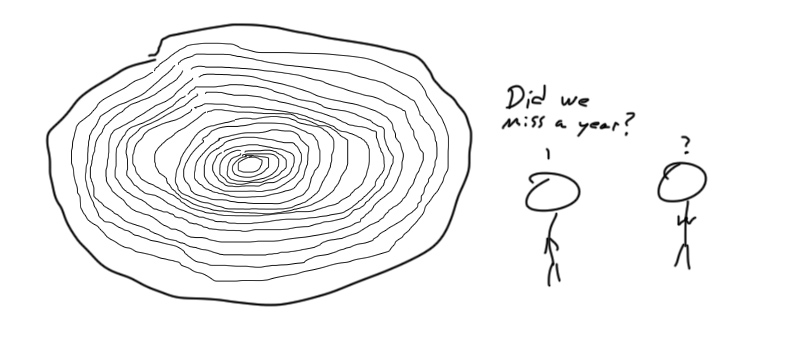
This is amazing: Scientists were befuddled by tree ring data not matching the natural cooling that follows a volcanic eruption. It turns out, in really cold years, we may not get tree rings at all. The data doesn't exist!

Tree-Rings
Missing Tree Rings

Seriously, read the whole article (it's written in a way that I was able follow most of it). This is an excellent contemporary example of how science works, and what it looks like while people try to make sense of what we observe.

Reminds me of apparent retrograde motion. Assuming the earth is the center of the universe produces very observable -- albeit incorrect -- models of how things work (check out this video and this one for a bit more). Similarly, assuming trees almost always add wood, the information we have doesn't make sense with the temperature measurements we've collected. Something strange is going on. ...or, perhaps, we've assumed the wrong things!

By stepping back and considering our limited perspective, we gain a better understanding of what's happening. And that is very, very cool. ...especially when it's paired with volcanoes and tree rings! I am so excited by this information; it reminds me yet again of how awesome life-long learning is.

I love science. I think a big part of my admiration was incubated in how I encountered science growing up.1 Science wasn't an abstract, out there, to-be-feared or dreaded topic. Instead, it was accessible, and a way to make sense of the world. Studying science and history also offered a great way to talk about interpretation, providing very real examples of what it means to get things wrong and learn from mistakes.2 When paired with history, we can see the strengths and weaknesses of science. It's a fantastic area of study with sci-fi-esque applications. Science is also all to susceptible to philosophical and political influence. Studying science as we did opened up discussion for other areas of study -- such as Scripture -- which are also colored by presuppositions. All of this nudged me toward humility and ever further study.

Okay, if you haven't yet read the original article, do so! It blew my mind and got me so excited about science yet again.

 ~Luke Holzmann
Filmmaker, Writer, Pseudo-Dad

1. If you have yet to experience Sonlight's hands-on Science programs, check out the Science Explorations which are fewer than $50 and come with a $20 Science package coupon if you order by the end of this month.

2. Here are just a handful of posts related to interpretation and scientific surprises: the discovery of a minor planet with rings (not thought to be possible), some thoughts on a comedian who thinks science is always right, my own ignorance of how planes fly, and a fun little bit about lightning.

Word of the Day
Dendrochronologists: those who study rings of trees to date past events

Brought to you by Greg Laden

Share this post via email


Submit
Tagged , , | Leave a comment

Kind words are like honey ...

Share this post via email


Submit

Someone offered some words of encouragement to me this past week ... twice in fact! Now you may think me desperate for blog material if I'm writing about something nice being said to me ... but stop and think about this with me for just a moment (and I promise it will be short).

When was the last time someone said something legitimately nice to you (as in, not flattery)?

When was the last time *YOU* said something encouraging to someone?

Solomon said "Kind words are like honey - sweet to the soul and healthy for the body." (Proverbs 16:24)  The encouraging words I heard this past week were just that ... very tasty to my soul and I'm sure they lowered my blood pressure at least a couple of points! Your words are far more than just "hot air" ... they have the potential to affect the people around you at a much deeper level.

I remember wrestling with this concept when I was still homeschooling our children. It was so very easy to regularly point out where they had done wrong, or to make them aware of my frustration with them ... but I did not share encouraging words with them nearly enough. Solomon also said "When she speaks, her words are wise, and she gives instructions with kindness." (Proverbs 31:26) I'm fairly certain, if you were to ask my children, they would not report that I always gave instruction with kindness.

So please let me "encourage" you to begin practicing "giving instruction with kindness" right now ... over summer break ... before the stress of the school year begins once again. It might amaze you how attitudes change and motivation increases. I guarantee that you will also benefit from being a "honey giver".

Still on the journey ...
~Judy Wnuk

Share this post via email


Submit
Tagged | Leave a comment

How Learning History Teaches Grace

Share this post via email


Submit

History is full of violence and horror, like when Cain killed his brother or Stephen was stoned to death. Plagues and floods, fires and starvation populate the unmarked graves of time. Yet in the midst of wars and droughts and bitterness and hatred, a stronger force emerges: Grace. God's grace for Cain, Stephen's prayer for his attackers, the people who have gathered to support and protect and encourage those affected by natural disasters and human oppression.

First-Responder
First Responder

Growing up with Sonlight, I learned from first-hand accounts how grace works. Grace from God to us and God's grace given through others to those in need. The men and women we read about -- and so lived life with them -- taught me much about grace. It doesn't take long in a person's story to encounter places where they have needed God's loving-kindness and peace and joy. A few pages more and we witness opportunities to share this goodness with others, and we can learn from their choices to lavish grace or withhold it.

As you discover history together in your History, Bible, Language Arts, and Reading or Full-Grade Package, you will have many opportunities to discuss grace.

Today, I appreciated Natalie Witcher's post on fake grace, a brief quote from Paul David Tripp, and the post Why I Don't Believe in Grace Anymore (yes, that's link-bait, but the post is good).

Grace. I certainly need more of it, and I should let God's goodness to me spill out more as well.

May the grace of God be evident in your life today.

 ~Luke Holzmann
Filmmaker, Writer, Pseudo-Dad

P.S. If you have any interest in Millennials -- either because you are one or know a few -- I found an article my wife sent me on why Millennials aren't in church to be thought-provoking.

Share this post via email


Submit
Tagged , , | Leave a comment

Did You Use Algebra Today?

Share this post via email


Submit

Just like the humorous image in this post, I have yet to use Algebra today. I haven't utilized polynomials, solved for a single variable, or graphed anything. But I did use Algebra the other day when I filled up my car's tank. I applied a simple equation to determine my miles per gallon: x miles / y gallons = z mpg

A week before that, I needed to calculate the percentage of conversions for a spreadsheet at work: (# of purchases / # of visits) * 100 = conversion %

Granted, outside of assisting high schoolers with homework, I haven't used an equation to find the slope of a line -- you know, y = mx + b -- since I was that age myself. But the fundamental practice of setting up an equation and keeping track of variables is useful on a monthly, if not weekly, basis. And that is one of the key elements taught in basic Algebra.

Summer is still in session for many kids. It's tempting to think that what you've learned is no longer applicable. We can wonder if there's really a point to returning to formal studies. It's not like we actually use any of this stuff!

But that's simply not true.

We may forget the details, but we retain the bedrock.

If your kids are still on break, encourage them to enjoy their vacation. But it may be helpful, every now and again, to point out the little instances where what they've learned is clearly applied in what they do.

Knowledge
Fire Hose of Knowledge

If nothing else, it's a helpful reminder to you that they are, indeed, learning.

 ~Luke Holzmann
Filmmaker, Writer, Pseudo-Dad

Word of the Day: desiccate - to dry up; dehydrate
Brought to you by What If?

Share this post via email


Submit
Tagged , | Leave a comment

Sonlight on Pinterest

Share this post via email


Submit

SonlightPinterestDuring the past few months I've been building Sonlight's Pinterest boards. It's been a lot of fun organizing Sonlight's books and materials into various categories.

Over the years as my family built our Sonlight library I kept the books organized on our shelves by Core level. Sometimes I would want to reuse books about, say, a particular world area, or a certain period of history. Then I would have to scan through all the shelves looking for what I needed. With that in mind, I have sorted our products into dozens of categories for easy reference.

What if you have a younger child sitting in on Core with an older sibling, and you'd like to pull in some books from the lower level Cores that would tie in? There are boards for American History for Younger Students and Eastern Hemisphere for Younger Students.

What if you'd like to take the time to do a unit study on, say, farms? Check out the Farm Stories board for some great books to go along with that theme. What if your children really love mystery stories? There's a board for that, too! What about games Sonlight carries? That, too... and many, many more!

Go check it out! I hope you'll find it helpful and will "follow" us there. Of course it's an ongoing project, but that's what makes Pinterest fun, right?

Enjoying the adventure,
~Karla Cook
Lifelong Learner

Share this post via email


Submit
Tagged , , | 1 Comment

Modesty as Respect

Share this post via email


Submit

I've seen lots of articles on modesty lately. With summer upon us, it feels like everyone is talking about what young women need to do to "keep their brothers pure," and how they find a line to walk between acceptance and beauty, and what constitutes acting inappropriately.

The word "modesty" makes me cringe a little. I picture someone swathed in cloth from head to toe. Someone who is not current on any level of fashion and who is unrelatable for the majority of people with whom she would interact.

Instead of modesty, I prefer to think of respect.

Respect for yourself means that you dress in a way that is empowering to accomplish your goals — be it exercise, a park date, or church — and attractive. It means that you are appropriate for your surroundings and are able to confident and comfortable.

The Bible talks a lot about women being beautiful; it was something they were naturally, and something they worked on. I don't think working at being beautiful is a bad thing. To dress yourself in a way that is lovely adds to the world, and we all need more beauty in our lives. Respect means taking time to figure out what beauty is for you and working at that, for you to say, "I'm worth spending time on. I'm worth investing in." So when you look in the mirror you see the daughter of God who is lovely.

Take a look at the show What Not to Wear (not an endorsement, though I personally do like it). They take women who dress in all sorts of ways, be it out of style, immodest, or whatever, and say, let us help you find what beautiful is for you. Each woman leaves feeling empowered and beautiful because they have the tools to dress themselves appropriately for their season of life.

When you respect yourself, you will not be immodest.

Respect for others means that you dress in a way that shows you know your audience, those that are around you, and your setting. It's why we don't wear jean shorts to weddings (unless that IS the setting!) and why we don't wear wet suits to the pool.

The current culture of the pool is bikinis, and so I work at loving the women around me and admiring their cute suits (while I sit in my maternity tankini). I seek to respect the culture and honor the women who are dressed in less than me. I don't know their motivation, but I can still love them, still honor them, still treat them as women worthy of respect. They are at the pool to spend time with friends while their children splash. They want to feel cute and fit in. And they do. Why would I take offense?

If I were to visit a country were showing your arms is not culturally acceptable, I would cover my arms. It is not because I feel showing my arms is immodest, I would just seek to be respectful of that culture.

When you respect your setting, you will not be immodest.

What do you think? Can we move away from "modesty" (since that varies wildly from culture and age) and talk instead about respect?

Jonelle

This book really has helped me to buy appropriate clothing for my body type, colors and fashion personality.

Share this post via email


Submit
Tagged , , | 2 Comments