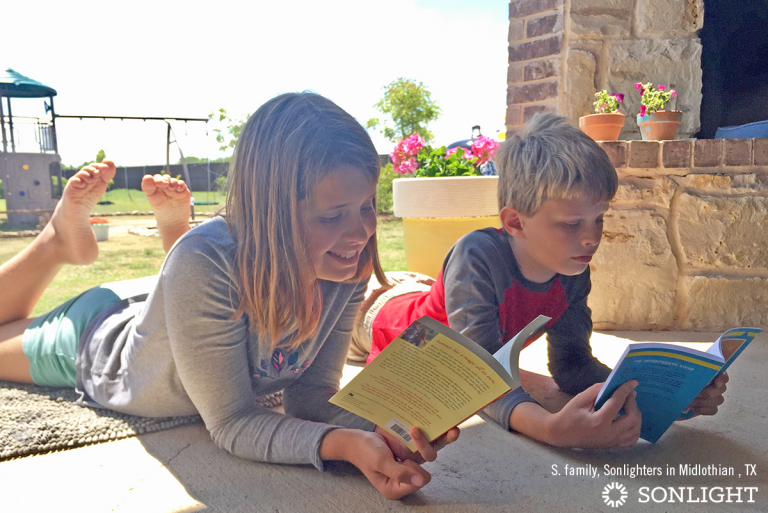
Q: Could Sonlight Fail You? A: Only If Your Goals Don’t Match Ours

Share this post via email


Submit
Q: Could Sonlight Fail You? A: Only If Your Goals Don’t Match Ours

Depending on your goals for homeschooling, Sonlight might fail your kids.

Sonlight won’t fail you if your goals are to

  • instill a love of great books and reading
  • develop empathy
  • lay a broad foundation of cultural literacy
  • expose children to multiple viewpoints and world cultures
  • root children in an overarching Christian worldview
  • train children who know how to reason, question, and dialogue about tough topics

If your goals don’t match those upon which Sonlight is based, yes, the curriculum might appear a colossal failure.

A Story of Mismatched Goals

For example, one mom said online that she regretted choosing Sonlight. She said that our literature-based approach failed her daughter miserably.

Why? Why did Sonlight fail in this case? Or, perhaps more telling, what did Sonlight fail to do?

This mom homeschooled with Sonlight A for Kindergarten and then chose to enroll her daughter in a Christian classical school for first grade. The results of the school's required placement test showed that this young child of the tender age of 5 or maybe 6 was “behind” because she didn’t have the phonics foundation this school expected.

The mother admitted that the school is advanced. For example, it uses Saxon Math 2 in first grade. But that admission didn’t curb her irritation that she now has to spend the summer getting her daughter “caught up” for this elite academy. She said, “I wish I would have skipped all of the fantasy stories and spent more time having her read to me and more effort on Phonics and Math.”

So the question here is whose goals did Sonlight fail to achieve?

Because of the emphasis on reading aloud to this Kindergarten child, Sonlight failed to get this girl ready for a first grade phonics test she needed to get into a private school.

Does that mean that Sonlight is a failure? We don’t think so! Passing that phonics test was not a goal for our History / Bible / Literature A program, so we wouldn’t measure our curriculum against that standard.

Does Sonlight Prepare Children for a Classroom Setting?

Sonlight may not prepare your child for a specialized classroom setting. And we’re okay with that!

First, Sonlight will not likely match a school's narrow requirements, not because Sonlight is somehow academically inferior, but because the emphasis is different. Every transition from one schooling approach to another requires a reassignment of priorities.

Second, Sonlight's Top 10 Goals could be (and probably are) different from the school you are considering. If excellence on phonics and math tests for young elementary students are the goals of a school, Sonlight's goals will not align.

If you are looking for a program that will cram testable standards into your child's mind in the first year or two of school, Sonlight may not be for you.

Sonlight Prepares Children and Teens for Life Beyond High School

To clarify, Sonlight is not a curriculum for slackers or dullards. Sonlight students excel at all levels—elementary school, middle school, high school, college, and beyond. If you want to see just a few examples of Sonlight students' success, see our Where Are They Now series. It’s both inspiring and reassuring to see where a Sonlight education has taken so many graduates: from missions to science careers and everything in between.

We can tell you boldly that Sonlight works. It has worked for over 30 years for tens of thousands of students to achieve the goals it sets out to accomplish.

If you are questioning whether Sonlight matches your goals, reach out to our homeschool consultants. Click here to schedule an appointment.

Share this post via email


Submit
Tagged , , , , , | 29 Comments

Memorization is Not Understanding

Share this post via email


Submit

Lumiere invites Belle to enjoy her dinner and sings, "Tie your napkin 'round your necksery and..."

Wait.

I'm standing in my kitchen and I realize there's a comma between "neck" and the next word. Suddenly the line makes way more sense. Excited, I share my discovery with Brittany, "He says, '...neck, chérie!'"

My wife stares at me, like I've just announced that "teh" isn't the correct spelling. Looks like I've got to explain myself. "I always thought it was a made-up word to make the line flow better."

My wife isn't impressed by my creativity in the face of ignorance.

I knew the song. I knew the movie. I knew the cultural context of the characters' names. But I didn't know there was a comma. All my memorization and knowledge had failed me. Until last night, I didn't understand what the candlestick was really saying.

This demonstrates the different strata of learning. Some of these layers are:

  • Comprehend
  • Recall
  • and Apply

I had the gist of the song, I knew it's meaning, and I could sing it to you if you were inclined to listen. But even though neither you nor I would realize I was singing it wrong, I wouldn't have been singing it correctly.

We need to be able to recall information we understand if we're going to apply it. Too often, however, we can get lazy and believe memorization is enough. This is the fundamental flaw of "teaching to the test": We never build on the foundation.

Homeschooling allows us to focus on the application of our knowledge. And if we can apply what we have learned, we know we also comprehend and recall the information as well. If you'd like some ideas on how to do this with your homeschool curriculum, Sonlight's Instructor's Guides offer notes and comprehension questions to help get you started.

Have you ever had a moment where you suddenly understood something you've "known" forever?

 ~Luke Holzmann
Filmmaker, Writer, Empty Nester

Share this post via email


Submit
Tagged | 4 Comments

Building Off Something Great

Share this post via email


Submit

There is a fantastic article in the latest edition of Wired. (Unfortunately, it's not on their website yet, so I can't link to it.) The article presents the radical shift in computing that is upon us because of the Kinect (and our ability to tap into its power). The short, short, short version: The Kinect solves a long-standing robotics problem and now that Microsoft supports the use of their hardware outside of the Xbox, we are moving into a new world of computing.

Wired is really promoting the ability to build off something great. The article cheers when tightfisted corporations surrender to the ingenious hacker who can take their product and use it in a new way. And I cheer right along with them. As you may recall, I tend to tweak my tools too. It's important to note that this is modding, not piracy. Modding creates more with what is there, piracy takes what isn't yours.*

How does this relate to homeschooling?

From what I've gathered, many people begin their homeschool journey by getting the recommended items or "boxed curriculum." Over the years, as they gain confidence in their homeschooling and insight into their children's learning styles, they begin to modify their curriculum selections to meet their needs.

In the end, you build off something great to make a home education just right for you and your family.


Modding Your Curriculum

Sonlight fully supports this customization. That's why we offer so many different homeschool curriculum options from complete packages to individual items. Of course, having such a great approach to homeschooling means that others "mod" Sonlight's foundation to create their own products as well. I admit that's a tad frustrating for me, but I also appreciate how this has brought homeschooling to a whole new level over the last 20 years. May your studies--no matter the form they take--enable you and your family to do amazing things and experience the joy of learning together.

 ~Luke Holzmann
Filmmaker, Writer, Empty Nester

*This is probably why I have such mixed feelings about derivative works online: It's rather a cross between modding and piracy. Fascinating!

Share this post via email


Submit
Tagged , | 2 Comments

Homeschool Support?

Share this post via email


Submit

It's summer and homeschool conventions are in the air. I've traveled to four so far this year to represent Sonlight in various exhibit halls. Perhaps because I am reaching the half century mark this year, I found myself comparing this year's conventions and attendees to those I remember when I first began attending conventions some 17 years ago. Reflecting on the differences has made for some interesting conversation with others of my "generation".

I also have the privilege of acting as the program director for a state convention here in the northeast. We will be holding our post-convention recap and strategy meeting this weekend. Each year this meeting causes me to consider the perceived needs and wants of homeschoolers and whether or not we are effectively meeting those needs.

In the "early years" of homeschooling, conventions were eagerly anticipated as an opportunity to gather with others of like-minded thought when it came to educational choices. It was a chance to re-group and be encouraged in the rather unique path you had chosen. There was an almost desperate need to hear that what you were doing was right and good.

Today's conventions seem to be more consumer-oriented. With so many to choose from, most folks have the option of attending at least 2, and maybe 3, within driving distance. In this age of Facebook and Twitter, "virtual conventions" are also beginning to appear on the horizon. Curriculum choices are available to preview online, live chat services offer a homeschool advisor at your fingertips, and homeschool forums, chat rooms and blogs, provide virtually everything that a "skin on" convention has to offer without ever leaving home.

So are homeschool conventions and local support group meetings headed the way of the dinosaur? Will they soon be extinct? I truly hope not. While I believe that technology is a wonderful and useful tool, there is just nothing that meets our built-in need for relationship and encouragement like a homeschool convention (or a support group meeting). As I stood on various convention floors this year and talked with new homeschooling parents, admired their babies and toddlers, engaged in some Homeschool 101 conversation, encouraged them that they CAN indeed do this homeschool thing, and hugged them before they left ... I considered time and time again that nothing will ever replace that eye-to-eye, face-to-face experience that an "in-person" event has to offer. It is worth the effort of finding child care, saving pennies for convention registration and possible hotel stay, and arranging transportation.

A thought to contemplate ... if you're a "veteran" homeschooler as I am, and really feel no compelling need to attend a homeschool convention ... consider how valuable your life experience would be to new homeschoolers just beginning their journey. Give some thought to volunteering or working on your local convention team as a means of "giving back" to those who supported you during the early years of your homeschool experience. I guarantee you it's worth your time and effort.

Still traveling the path ...
~Judy
Sonlight Customer Champion

Share this post via email


Submit
Tagged , | 2 Comments

Summer Bummer

Share this post via email


Submit

This morning I read about how Erika's family is already missing school. Such a problem to have! <smile>

It's been a long time since I had a summer break. Even when I was finishing up high school, I was creating Science DVDs instead of playing with the friends I didn't have. So I'm reaching back in my mind when I think about my childhood summers. I don't recall missing school because we still got up early to go to swim practice, we still read every night before bed, we still had fascinating family discussions, and I spent a ton of time at my friends' houses (like I did while we did school as well).

But, yes, summer isn't always all that it's imagined to be. The change or loss of routine, the cries of boredom, the heat, the schedule that seems to fill up even more than during the rest of the year... all conspire to bring about a summer bummer.

My suggestion? Grab one of your favorite books--or one that you didn't get to--and read together on a regular basis, like bedtime. Interested in something new and fresh? You could always start reading some of next year's books now, especially if you were thinking of doing a 4-Day program. You could get the 5-Day Core program just to have a couple extra books to read over the summer.

Looking for a few more suggestions? Kelly, Jill and Judy have some great summertime tips:

Are you enjoying your summer? What great things are you planning to do?

 ~Luke Holzmann
Filmmaker, Writer, Empty Nester

Share this post via email


Submit
Tagged | 5 Comments

What Good is Christianity?

Share this post via email


Submit

According to a study by Barna Research, 61 percent of twentysomethings who were once active as teens in churches "are now spiritually disengaged."

Why is it that so many young Christians eventually "disengage" from the faith? There are likely a number of contributing factors. One of them may be a lack of facts when it comes to understanding the many positive contributions Christianity has made to the world. Also, with so many contemporary challenges to the Christian faith, from hostile skeptics to competing religious beliefs, many Christians aren't sure how to respond.

With these points in mind, Sonlight recently completed development of What Good is Christianity? This is an exciting and stimulating 18-week, upper-level high school curriculum designed to equip teenagers as they prepare to graduate, pursue college studies, and begin their adult lives. Along with Sonlight's president, Sarita Holzmann, I worked hard to bring together the finest resources to make What Good is Christianity? the best that it could be.

Although the primary emphasis is on the facts of Christian history, noting Christianity's many positive influences, What Good is Christianity? also covers a lot of related ground. For instance, we address criticisms of the so-called new atheists, as well as the relationship between Christianity and the fine arts, literature, science, charity, democracy, social justice, and more.

We've brought together seven wonderful resources (six books and a DVD set), plus our detailed Instructor's Guide that includes numerous notes, suggested assignments, discussion questions, and bonus articles on important topics.

As a father of four homeschooled children, I want to do whatever I can to keep my kids from becoming one of the 61 percent who will ultimately "disengage" from their faith. Are your high school children ready to face the many challenges to their faith? Help prepare them with What Good is Christianity?

Why do you think so many Christian youth eventually "disengage" from the faith?

Robert Velarde
Product Development
Sonlight Curriculum

Share this post via email


Submit
Tagged , , | 21 Comments

Gender Matters in Education

Share this post via email


Submit

Gender is showing up in articles again and again and again these days. The basic thrust of this in vogue idea--which appears to have been around for a little over 50 years now--is that "gender" is more than just your physiology.

Okay, sure. But this idea is no more enlightening than to say that "orange" can refer to a fruit, a color or a non-rhyme-able word. Far more important is to consider the deeper root of the discussion. Are we talking about food or art or creative writing? Similarly, we must unearth what is driving this latest thrust to let our children "discover"/"decide" their gender for themselves.

To me, Storm's parents are simply confusing the issue. While social pressures do affect how we treat boys and girls--often damagingly so--the solution is not to try to mask biological gender. Rather, as Dr. Sax so masterfully explains: We must learn about the innate differences in biology so we can give our sons and daughters equal opportunities to succeed. In fact, I would argue that trying to ignore biological differences will make it harder for a child to develop because the innate differences are not addressed and applied.

The other issue is similarly mislabeled. The roles and preferences of children are not defined by society any more than they are by biology. Both impact the student, to be sure, but personality, opportunity, and aptitude are equally influential. To put such an emphasis on essentially overthrowing one's biology is a mistake. If anything, we should overthrow society's limitations and work within the various strengths our biology gives us as we pursue the things of which we are gifted and blessed to take part.

I've written about Dr. Sax's Why Gender Matters before, but this issue has come up yet again. Dr. Sax champions the point that understanding biology frees us from the assumptions of society. Gender matters in education because if we do not take the time to understand how it influences our lives, we will be limited by our ignorance.

If you have not read Why Gender Matters, I urge you to do so. I was blown away by what I learned. And considering how hot of a topic this is today, now is the time to get the facts.

Have you noticed a recent glut of gender discussion? What are your thoughts and insights?

 ~Luke Holzmann
Filmmaker, Writer, Empty Nester

Share this post via email


Submit
Tagged , | 3 Comments