Sonlight is Not for You

Share this post via email


Submit

If you're using Sonlight and loving it, please disregard this post. It's not for you.

Similarly, Sonlight may not be right for you or your family. How can you know if Sonlight is not going to be good fit?

Here are 27 reasons not to buy Sonlight. Read them. Think them over. And if you agree, please go find a homeschool curriculum that is going to better meet your needs. Sonlight is successful because we know what we do well. And I want to make sure you are successful in your homeschooling journey by focusing on the things you do well.

Again: Please read the 27 reasons Sonlight is not for you.

Still not convinced Sonlight is the wrong curriculum for your family? Okay, then check out our one-year guarantee that you'll love using Sonlight! Because if Sonlight is for you, you're going to love it. Guaranteed.

 ~Luke Holzmann
Filmmaker, Writer, Empty Nester
Share this post via email


Submit
Tagged , , | Leave a comment

Books Inspire Thought

Share this post via email


Submit

I often feel ashamed to quote from the book I most recently read. I think my discomfort is based, partly, in a scene from Good Will Hunting where Matt Damon's character shows that a cocky grad student is merely parroting a passage and not actually thinking about it. [Note: I am not recommending that movie. It is full of inappropriate content and tons of swearing. But, if you're interested in the entire quote--which is quite fascinating despite the f-bomb--you can read it here.] In the end, Matt Damon suggests the guy should borrow books from the library rather than spend a fortune on his degree.

And, in many ways, he's right. If your formal learning experience merely ensures you can regurgitate information on demand, you've failed to get an education.

Of course, interacting with an idea and applying it to an experience is exactly what an education is all about! So there is nothing wrong with "trying out" the ideas you agree with in a book. And if you're applying a passage, you're thinking about it. And, sure, someone may respond to the idea you present with a rebuttal, but that's normal. Disagreements--when handled with honesty and love--help us discover truth.

So, please, talk about the books you read. Build off the things you've learned and connect them to ideas you already had. Weigh them against each other. Question. Consider. Read more. Because books inspire thought when your goal is to use what you've learned to do more than impress some girl or embarrass someone else.

 ~Luke Holzmann
Filmmaker, Writer, Empty Nester

Share this post via email


Submit
Tagged , | Leave a comment

Math Facts Forwards and Backwards

Share this post via email


Submit

"Let me do the multiplication part," she says. "I love multiplication!"

We're currently learning about fractions and decimals and percents. Becky has auditory processing delays so she can't remember all the steps or formulas involved in solving the problems. Every day I go through each problem with her step-by-step. She tracks along with me and seems to understand the basic concepts, but she wouldn't be able to do the complex problems on her own.

Multiplication, though? She's got that nailed.

She actually knows her facts better than I do. I never can remember... what's 7x6 and 8x7?

Let me think just a minute.

Oh, yes... 42 and 56.

Dare I admit that I got that by counting forward from 6x6 and 7x7? Math is not my strong suit. And I think I know why. Having to calculate the basic facts while working more complex problems can get confusing and frustrating. Memorizing those tables by rote is so important.

I can see that now. Too bad I didn't when I was 10.

My daughter is 17, so we've been working on the math facts for several years. That's normal for her. Everything she learns has to be repeated many, many times over many months. And so, I utilized a wide variety of systems to help her memorize the multiplication tables. We tried:

  • Flash Cards... which might have eventually worked, if I hadn't gotten so utterly bored going over and over them.
  • Multiplication Songs... and Becky cheerfully memorized the tunes but got the numbers garbled.
  • Drill Worksheets... which quickly got tedious and actually seemed to reinforce mistakes as Becky might write a wrong answer and not realize it.
  • Mnemonic Stories... which were very cute and worked temporarily, but didn't seem to stick long-term.

While she did know some of her facts, Becky often had to resort to counting on her fingers or making tick marks on a paper to figure out the harder ones.

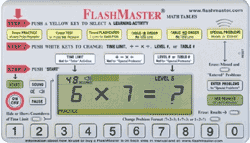
So how did she finally nail them? I have to give credit to a handy-dandy device that Sonlight carries called FlashMaster.

flashmaster-thumbWhen Becky reached high school age, I started giving her a list of assignments and tasks she needed to complete independently each day before she could say she was "done with school" for the day. I put FlashMaster on her list. I showed her how to set the device at the lowest/easiest level and told her I wanted her to go through the sequence twice each day. Once she started getting 100% on that level, she was to change the settings to move up to the next level. And that was it! After a few months I noticed she was remembering the answers. No more having to stop and figure it out in the middle of a problem.

Now that she's got the multiplication tables memorized I told her I wanted her to start over with division. She moaned at the thought. "Look!" I told her. "Division is just backwards multiplication. You know the multiplication answers, so you'll know the division answers, too." That hadn't occurred to her. For most kids that step wouldn't be necessary. But for her, it's a good way to reinforce and review what she's learned.

By the time she's done she will literally know her multiplication facts forwards and backwards.

Now, if there were only such a thing for counting money and telling time.

Enjoying the adventure,
~Karla Cook
Lifelong Learner

Share this post via email


Submit
Tagged , , , , , | 3 Comments

Online Learning: Do You Want to Grasp a Concept or Gain a Skill?

Share this post via email


Submit

He was a motivated film student at a University, often seen around campus in baggy t-shirts and short shorts. Impressed with computer graphics, and intrigued by an amazing free 3D rendering program, he opened one of their many free online tutorials. He was going to learn how to build a three-dimensional door. Easy enough.

Four hours later he had a round-ish blob next to a rectangular-ish blog, a headache, and little else.

Door
Door

Today, he only rarely dreams of creating things inside his computer. But every now-and-again the crazy idea rears its head and he looks for yet another tutorial that may help him understand.

This poor soul isn't actually interested in gaining a new skill. He has told me, more than once, that he doesn't have time to devote to these technical pursuits. Instead, he keeps yearning to understand how creating computer graphic elements works. He wants to "get his head around" the complexities of CG work. So, it's little wonder he keeps looking for tutorials, but it's also obvious why he keeps "failing" the classes he finds online: He wants to grasp the concept, but he doesn't want to actually put in the time to master the task.

I think a similar thing is at play in online courses, which can boast up to a 90% dropout rate. In fact, when I heard about the free artificial intelligence college course, I almost signed up. But then I learned that there was homework and deadlines and the like. So I "dropped out" before I even registered. I was interested in the topic, and would love to understand it a bit more, but I'm not looking to learn how to code an AI.

In the world of blogs and podcasts and YouTube videos and infographics and webinars, we can quickly grasp big ideas. Free online courses are built for something else entirely. They are designed to help you gain a skill... and that takes work. In my own experience with my free film school, I've had a bunch of people sign up, several complete the first assignment or two, but only one student has finished the course.

Is that a failure of my online class?

It could indicate a problem with how I built it. But more than that, I think most of my would-be students are more interested in learning about filmmaking than actually becoming filmmakers. Because, honestly, gaining a new skill--be it filmmaking, programming, cooking, writing, or otherwise--takes a significant investment. And when the tempting offer of free is coupled with a natural curiosity and interest, people will come check it out. But, perhaps, a good YouTube video on the subject is a better fit for those interested in learning more.

What do you think? Have you taking an online class or used a tutorial to gain a skill? Did you discover--part way in--that you were actually more interested in the topic than the practice?

 ~Luke Holzmann
Filmmaker, Writer, Empty Nester
Share this post via email


Submit
Tagged , | Leave a comment

A Gift to Your Child's Future Spouse: Organization Skills

Share this post via email


Submit

When I asked if homeschoolers need to teach organization skills, Anne-Marie wasn't so sure. She replied:

"I would think homeschooled kids are less likely to need formal teaching [in organization skills], because they are more likely to see the creation of individualized organizational systems and to hear the rationale behind the systems."

In other words, kids see us organize our lives and belongings at home. They see our systems at work. So in theory, they absorb organization skills. Great point. But how do we help make sure our children really learn organization skills? I have two simple suggestions:

Think out loud

When you get more books or clothes, ask them, "Where should we keep this so we always know where it is?" And then create a place for it.

Let your kids in on your thought processes. Demonstrate how you think through problems and come to solutions. It's a simple yet effective gift to give your children. (Thinking out loud also works effectively in teaching writing.)

Create a place for everything ... then put things away

We've all heard it before, but I find great wisdom in "A place for everything, and everything in its place."


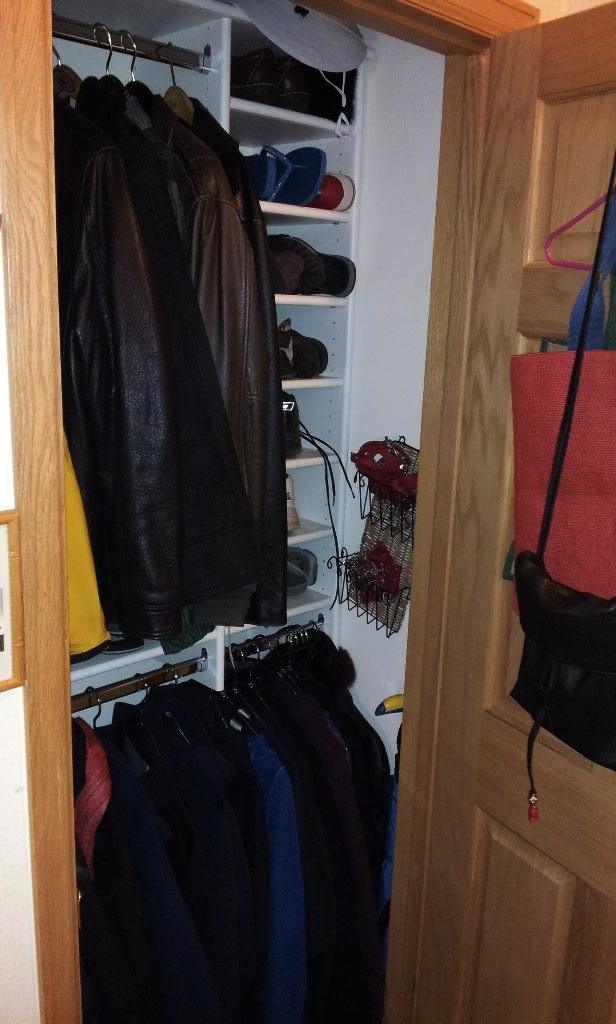
Our entry-way closet, with a place for everything.


Close the closet door and I have instant neat! (It's the simple things, right?)

Am I just compulsive? (Maybe.) But I don't waste time and thought finding somewhere to hang my coat; I always use the same hanger. When I leave the house the next time I know exactly where to find it.

That's the goal with having a place for everything: you don't have to think about it.

Don't you have enough on your mind? Why waste the energy trying to call up a mental snapshot of where you last threw your keys? The goal is to have as few of those moments as you can. So if you don't have a place for your keys, try to pick one now.

Again, this concept is something to model to your kids. For example, explain to them how you've organized your school space and why. Ask if they have ideas of where to keep their new science supplies. Ask for suggestions on the setup. They just might have a great insight.

Whatever our systems for organization, may it be that we model them to our kids. May we raise up children who are orderly and organized. I'm here to tell you that one day their spouses will thank you!

Blessings,
Sarita

P.S. If it's hard to put things in their place or even create organization systems because of clutter, you may be wasting precious time. It's just not worth having too many things in your closet or around the house.


For simple help decluttering, check out a helpful PDF from our Sonlight homeschool consultants: Conquer Your Clutter in 8 Easy Steps.

For more intense help getting your house under control, I'd recommend The FlyLady. I haven't personally used her system, but I know many who have. I love her tagline: You are not behind! I don't want you to try to catch up; I just want you to jump in where you are. She reminds you that imperfect housework still blesses your family (and yourself).

Share this post via email


Submit
Tagged | Leave a comment

Our Understanding Develops; Ideas Stay the Same

Share this post via email


Submit

After reading the first part of Mark 5, where Jesus sends the Legion of demons into a herd of pigs, the small group of guys briefly discussed demonic activity. Of those present some grew up in the church, but none of them had done any formal Scripture study. One expressed doubt in the visible manifestation of demonic possession--such as violent outbursts--while another said he had personally witnessed four different accounts of possession.

"What do you think of demon possession, Luke?" Five pairs of eyes turned to me.

I teach Sunday School and am familiar with waxing eloquent on passages of Scripture. But it's different when you're only a participant in a brief morning devotional. It's difficult when you're with a group of guys, mostly older than you, who possess an unknown familiarity with various concepts. Possession vs oppression? Cultural expressions of spiritual warfare? Historical precedent and medical studies? What do they need to know?

My response was drawn from the many Sonlight missionary biographies I was raised on and coupled with a brief hint of my own experiences. They nodded and then another guy spoke. "I think this passage shows Jesus' power over everything else."

That about sums it up. Is there more? To be sure! But that can be uncovered as our understanding develops. The foundational idea remains: Jesus has authority. Our understanding of Him does not. Our perceptions and conceptions can grow, but the idea is unchanged.

This experience reminded me of a passage from C.S. Lewis' God in the Dock, where he discusses "Dogma and the Universe," specifically the question of "How can an unchanging system survive the continual increase in knowledge?"

A great Christian statesman, considering the morality of a measure which will affect millions of lives, and which involves economic, geographical and political considerations of the utmost complexity, is in a different position from a boy first learning that one must not cheat or tell lies, or hurt innocent people. But only in so far as that first knowledge of the great moral platitudes survives unimpaired in the statesman will his deliberation be moral at all. If that goes, there there has been no progress, but only mere change. For change is not progress unless the core remains unchanged.

Progress is built upon a solid foundation. We may, in time, learn more of what the foundation is made and how, but it endures. I find this humbling as I speak with people about big and fundamental ideas. I find this cautionary as we discuss the expression of an idea. I find it encouraging as we re-encounter basic ideas with our children and learn, once again, that for all our knowledge, the core is still intact and we are better for returning to it now and again.

 ~Luke Holzmann
Filmmaker, Writer, Empty Nester
Share this post via email


Submit
Tagged , , , | 2 Comments

Does Preschool Help or Hinder Children?

Share this post via email


Submit

My wife, an Education major, nods as President Obama says in his State of the Union address:

In states that make it a priority to educate our youngest children ... students grow up more likely to read and do math at grade level, graduate high school, hold a job, form more stable families of their own.

Studies do show that children in homes where parents are not around much--through neglect or need--benefit significantly from preschool. This time gives them routine and adult involvement and opportunities to learn. All very great things! On the other hand, I've read that an emphasis on early academics actually stunts a student's future performance (not to mention socialization skills).

What's going on?

My guess is that kids thrive when concerned adults look after them and that an education is best acquired when it is allowed to blossom.

So, I am pleased that the President wants to offer children more care, especially if these children do not have parents who can look after them. Caring for children--especially orphans--is a noble goal (though, I'm unsure how that will be accomplished and not "increase our deficit by a single dime"). On the other hand, I would like to know more about what a "high-quality preschool" looks like. If it is an environment full of picture books and opportunities to discover the joy of life-long learning, fantastic! If, on the other hand, it is a place that pushes laying a foundation for "science, technology, engineering and math," I'm afraid the results will backfire.

My wife tells me that the skills best learned in preschool are soft skills. And these, not surprisingly, seem best taught by parents.

I'll say it again: You, the parent, have the biggest impact on your student's succcess. In situations where the parent is not there, a great teacher can help fill this role. So for those children without parental support, I'd be thrilled if we could help them by providing excellent teachers. And I continue to say, especially in preschool, it is best to begin with a gentle approach that inspires a love of learning together.

Any fascinating educational studies you've read that I should know about?

 ~Luke Holzmann
Filmmaker, Writer, Empty Nester

Share this post via email


Submit
Tagged , , , , , | 4 Comments
