Helping Families Navigate Santa, Wonder, and the Story of Jesus
Some parents worry that any attention to Christmas magic will distract from Jesus. But it doesn’t have to be either/or. It can be both/and.

"'Twas the night before Christmas, when all through the house, not a creature was stirring, not even a mouse." For generations, Clement Clarke Moore's beloved poem has painted a picture of Christmas Eve wonder—stockings hung by the chimney, visions of sugar plums, and the sound of reindeer hooves on the roof. It's a tradition woven into the fabric of countless family celebrations.
But for Christian parents, the poem raises an important question: How do we balance the enchantment of Santa Claus with the profound truth of Jesus's birth? Is there room for both flying reindeer and shepherds in the fields? Can twinkling lights on the Christmas tree coexist with the Light of the World?
The answer is deeply personal and family-specific. There's no single "right" approach to Christmas traditions. Some families embrace Santa wholeheartedly alongside their celebration of Christ's birth. Others skip Santa entirely, focusing exclusively on the nativity. Some families also enjoy sharing the historical story of Saint Nicholas—a Christian bishop known for generosity—which can help connect cultural traditions to Christian faith and history, while still celebrating Jesus.
Many find themselves somewhere in the middle, weaving cultural traditions and gospel truth together in ways that reflect their values and their children's needs. Like many matters of Christian freedom (Romans 14), how families approach Santa is ultimately a wisdom issue, not a salvation issue. Faithful Christian parents may arrive at different conclusions while still honoring Christ.
What matters most isn't whether you include Santa in your celebrations—it's whether Jesus remains at the center. The goal isn't to eliminate wonder and delight from Christmas, but to ensure that the greatest wonder of all—God becoming human to save us—captures your family's imagination most fully. Christ alone deserves our worship, and all cultural traditions—if included at all—must remain clearly secondary, never competing with His glory.
Both/And Not Either/Or
You don't have to choose between cultural traditions and gospel truth. You can read 'Twas the Night Before Christmas AND the Christmas story from Luke. You can sing "Jingle Bells" AND "O Come, All Ye Faithful." You can enjoy twinkling lights and decorated trees AND keep your primary focus on the incarnation.
The key is proportion and intentionality. As long as Jesus remains central, as long as your children clearly understand the gospel, as long as wonder at the incarnation exceeds wonder at cultural traditions, you can embrace the beauty of both.
After all, we worship a God who loves celebration, who invented beauty and delight, who designed humans to experience joy. He's not opposed to wonder—He invites it. He just wants that wonder directed toward Himself. For families who choose not to include Santa out of a desire to guard truthfulness or avoid confusion, that choice is both understandable and honorable.
Wonder Isn't the Enemy of Worship
Some parents worry that any attention to Christmas magic will distract from Jesus. But consider this: God Himself designed humans to experience wonder and awe. He created a world full of beauty, mystery, and delight precisely so we would marvel.
The problem isn't wonder—it's misdirected wonder. The goal isn't to eliminate all sense of magic from Christmas but to ensure the greatest wonder is directed toward the incarnation itself. When we speak of “wonder,” we don’t mean mystical power or superstition—we mean the childlike awe and joy God built into us as His creation.
Think about it: God became human. The Creator entered His creation as a helpless infant. Divinity clothed in flesh. The Word who spoke galaxies into existence learned to babble "mama" and "abba." Eternal life subjected Himself to time, hunger, tiredness, and eventually death.
If that doesn't fill you with wonder, you're not paying attention. The incarnation is the most astonishing event in history. It makes flying reindeer look mundane by comparison.
So cultivate wonder in your children. Let them feel the enchantment of candlelight, the mystery of wrapped gifand ts, the anticipation of Christmas morning. But make sure the most wonder-inducing element of Christmas is the gospel story itself. Some families choose to enjoy Santa as a clearly identified story or symbol, while being open with their children about what is pretend and what is true—protecting trust while still allowing room for imagination.
Practical Ways to Keep Christ Central
If you’re looking for ways to balance cultural traditions with gospel truth, consider the following:
- Read the Christmas story (Luke 2) multiple times. Don't just read Luke 2 on Christmas Eve. Read it multiple times throughout December. Let it be as familiar as ‘Twas the Night Before Christmas. Make it the story your children know by heart.
- Create gospel-centered traditions. Advent wreaths, nativity scenes, Jesse trees, and Christmas carol sing-alongs all focus attention on Christ's birth. These traditions create space for conversation about why Jesus came.
- Use Advent to build anticipation. Just as secular culture builds excitement toward Santa's arrival, use Advent to build anticipation for celebrating Jesus's birth. Count down. Talk about how people waited centuries for the Messiah. Let the excitement mount toward Christmas Day.
- Give gifts that point to Jesus. When you give presents, explicitly connect them to God's gift of Jesus. "We give gifts at Christmas because God gave us the best gift. Everything good in our lives comes from Him."
- Serve others. Make service a central part of your Christmas celebration. When you focus on giving to others, you're reflecting the heart of Christmas—God's sacrificial giving to us.
- Attend Christmas services. Worship services keep the focus on Jesus. Even if your children squirm through parts of it, their presence in a gathered community celebrating Christ's birth reinforces what Christmas is truly about.
- Display the Nativity prominently. Your nativity scene should be central in your decorations—not tucked away or competing equally with secular decorations. Let it be clear what holds primary importance.
- Pray together. Throughout the season, pray prayers of thanksgiving for the incarnation. "Thank you, Jesus, that you came to earth as a baby to save us."
Answering Children's Questions
As your children encounter different approaches to Christmas, from purely secular to strictly religious, they'll have questions. Here are some starting points on how you might respond:
- "Why do some families do Santa and others don't?" "Different families make different choices about traditions. What matters most is that all Christians celebrate Jesus's birth. How families include or don't include other traditions is up to each family."
- "Is it wrong to enjoy Santa stories?" "No! Stories can be fun even when they're not true. We can enjoy 'Twas the Night Before Christmas just like we enjoy other fairy tales. But we remember that it's a story, and the real, true story of Christmas is even better."
- "Why do we give presents if it's Jesus's birthday?" "That's a great question! We give gifts to each other because God gave us the gift of Jesus. Our giving reminds us of God's generosity to us."
- "If Jesus is what matters, why do we have a Christmas tree?" "We can enjoy beautiful traditions that make Christmas special without them being the main point. Think of them like decorations at a birthday party—they're fun and make the celebration nice, but they're not the reason for the party. At a birthday party, we celebrate the person whose birthday it is. At Christmas, we celebrate Jesus."
When Cultural Elements Become Too Much
Pay attention to what's capturing your children's imagination and excitement. If they're significantly more interested in what they're getting from Santa than in the story of Jesus's birth, it's time to rebalance.
Some signs you might need to adjust:
- Children can name all of Santa's reindeer, but don't know the Christmas story.
- More energy goes into Santa activities than into worship or service.
- Children are anxious or obsessed with behavior because of "naughty or nice" concerns.
- You realize you've inadvertently taught more about North Pole mythology than about Bethlehem history.
If this happens, don't panic. Simply recalibrate. Scale back secular elements. Increase gospel-focused activities. Have direct conversations about what's real and what's pretend, what's central and what's peripheral.
In life, it's all about balance. When the balance gets "off," we shift things to bring it back into alignment. And if you are going to be off-balance, err on the side of Jesus. Our goal isn’t perfection but faithfulness in pointing our children toward Christ.
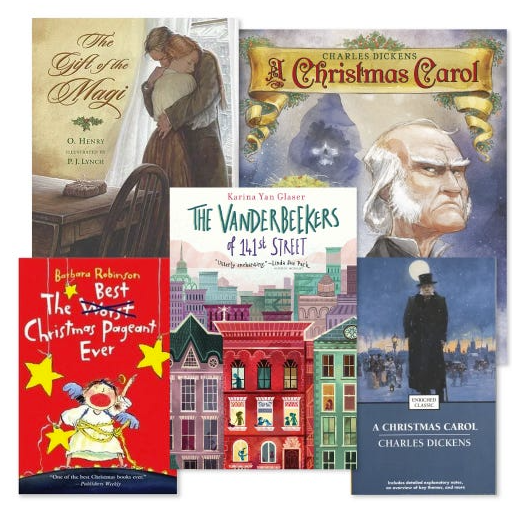
Looking for books that center Christ in the Christmas story? Sonlight books are the best books because we are so selective when it comes to our collection, including our Christmas books and bundles.